

All Activity
- Past hour
-
Sale of the Century - Sleeper
-
Both were brand spanking new $2.6k walnut Rickenbacker 4003s some fella on Talkbass got last December. First photo was the one he received on the 9th, 2nd photo the replacement delivered on the 16th. I posted it in response to Michael's "It isn't a perfect bass like you'd expect from a US Fender either." Badly cut nuts and poor fret work are not exclusive to budget basses, you'll see both on any production line brand; even premium priced brands. I know those are Rics but Fender US can be just as bad; same for Gibson.
-

Post your pedal board - Basschat style!!
javi_bassist replied to dudewheresmybass's topic in Effects
I thought that I could, but I have not tried it. Should I plug the monitor send to the fx return? -
Not sure if that was directed at me or not, but I thought the whole point of a forum is to be able to voice opinions and discuss the reasons for our subjective preferences. Personally, I've found that in the gig circumstances where 200w is enough through 2x 10" drivers, then I can instead get away with just 1 driver if I push it using a 500w amp - remembering that at 8 ohms I'd only be getting about 130 Vs 300 watts based on typical amps on the market at those sizes. Plenty of good drivers nowadays will happily take 200 to 300w all day long so it makes sense to me to have amps that match that. For me, whatever solution gets me to gig volume for least size/weight is my preference. As mentioned by DGBass above, the likely reason why there is a plethora of 200w amps is, that's where the current technology is at in terms of cost sweet spot. Rather than it being the wattage the market 'demands'. With the previous generation of slightly larger and more expensive class D modules that spot appeared to be around 450-500 watts.
-
Was it Woolworths?
-
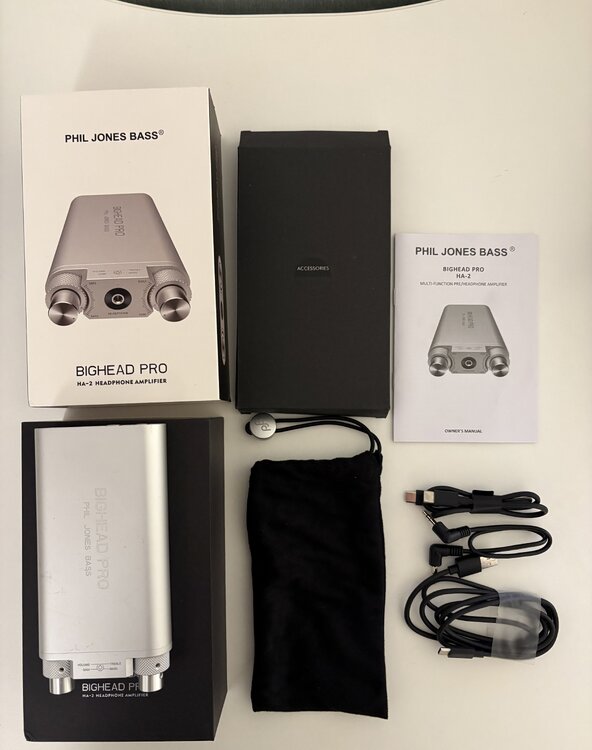 Phil Jones Bighead Pro HA2 for sale. Bought from new from Bassdirect and had it about a year I think. Looking for £200 £180 £165. I'm based in Cambridge. Here is some detail about the unit plus a photo or two and a link to a Youtube video. Mobile High Performance Multi-Function Headphone Amplifier/Digital Audio Interface The HA-2 is the second model in the Bighead series and is a step up model of the popular HA-1 Bighead with added technology and features. The HA-2 is a high resolution USB audio interface that supports PCM playback with up to 384 KHz sample rate/24 bit resolution. On DSD playback, sample rates of 2.822MHzand 5.644 MHz are supported, making it the ideal choice for musicians and engineers that desire high performance and the purest sound quality. It is a rechargeable lithium ion dynamo that is ideal for use in practice or recording situations. It also functions as a headphone booster amp as well as a preamp to drive powered amplifiers. The HA-2 has both passive and active instrument inputs with a 2 band EQ that is ideal for guitar and bass, yet versatile enough for use with other instruments. It has an internal lithium-ion rechargeable battery that is fed by its USB jack, so any computer or appropriate cell phone charger can charge it in less than 3 hours, but it can play for up to 8 hours. Model: HA-2 Power Output: 300mW/ channel, Headphone Impedance: 16-64 OHMS Frequency Response: 10Hz-40KHz Controls: Master volume, input gain, treble/bass for instrument input signal, headphone jack, line out, AUX input, micro USB for battery charge and digital interface Power: Internal lithium-ion Rechargeable Battery or USB Power Dimension: 3” x 5.9” x 0.9” (WxDxH) Weight: 0.6lbs / 290 g Other: Includes soft bag, stereo signal cable, and micro usb cable
-
- 2
-

-
everything must go - Manics
-
Well, each to their own. Personally I think the whole "too loud for home practice" thing is a false argument - amps have got volume controls. Until I got my Joyo 30W Vibe Cube, I was using my TC Electronic BH250 just fine for home practice - although mostly in headphones because I couldn't be arsed trotting out a cab. The only reason I got the Joyo was because it's more plug and play so I might practice at home a bit more (so far this seems to have borne fruit). I also don't really see why a 200W amp has to justify its existence to one particular person - the market as a whole will decide if it works or not. You buy one, or don't, and that's absolutely fine. There's a whole lot of IMO going on here, and while that's fine and dandy, it just gets argumentative in the end. You don't like/get them - fine, don't buy 'em. There are plenty folk who do. Like I said, I'm going to gig my 250W backup head tonight in a pub gig with no PA support and I'll report back as to how lacking or not it was, how does that sound? Does it even matter? I'm not you after all, I don't play in your venues or in your bands, so maybe I'm just wasting my time.
-
I understand well enough the relationship between watts, speaker sensitivity and volume. But (for example) wattage doubling tends to be dismissed as 'only' 3 dB difference ignoring the fact that a few dB is usually the difference between keeping up or not in the type of venue where you rely on backline. Super small amps are great but if I have to add more speakers they've made a bigger problem than the one they solve. My very cheap ~800w Bugera Veyron is only a little bigger than a Trace Elf or similar, and only a couple of kg heavier. If I'm using modern long-throw drivers that can handle the wattage, then I can squeeze close to 6dB more out of them than at 200, with barely any extra packing space or weight compared to doing the same by doubling my speaker complement. In practice that means my 2 DIY 1x10" cabs made well over a decade ago have handled any gig I've thrown at them and I've always had that 'punch' you get from having a little headroom at the amp. My 500w F1 used to work ok but was occasionally at its limit, whereas 200w wouldn't reliably be enough. I also agree with @la bam that in practice, for whatever reason, turning volumes down on powerful setups doesn't usually have the same effect as using a smaller rig. But that might be as much a speaker thing. I wish I could find a good lightweight 8" driver (or even 6") optimised for high power handling, low resonant frequency, medium Q and low sensitivity. Something towards the old Acme B1 but even smaller and less sensitive.
-

Canadian Dingwall Super P4 Fiesta Red/Wenge Fretboard Now £2300
walshy replied to Tripehound's topic in Basses For Sale
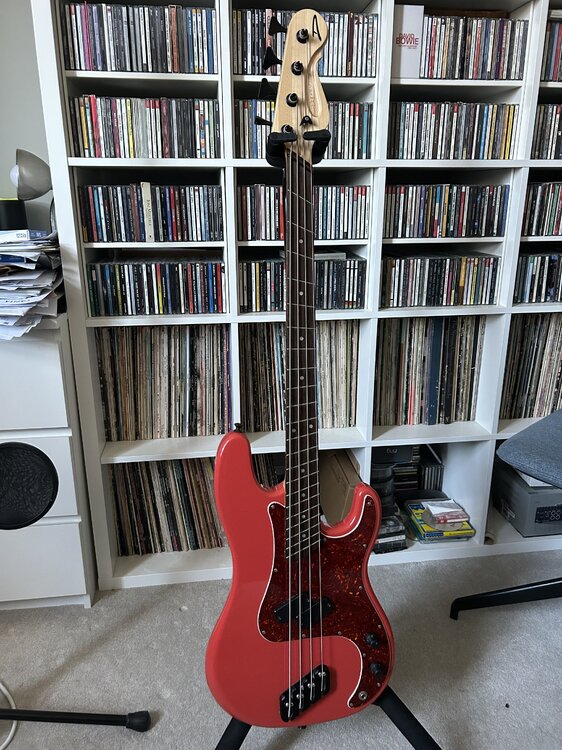 Sweet
Sweet -
 I am popping this back up for sale, as I've decided I prefer headed basses, with a very skinny nut. The funds will go towards a headed fretless 6 string ACG to compliment my recently acquired ACG fretted 6er, therefore no trades please. Here we have an immaculate ACG Krell SC E Type, a stunning example of ACG's work. This is a 6 string, tuned B to C, headless, set-neck construction. The scale length is 31.5" and the playability is incredible, the low B is musical and lacks nothing compared to long scale basses. As you will see from the design at the "head end", the strings are held in with grub screws so you can use any strings you want, you are not tied to double ball end strings. This is probably the most beautiful bass I have ever owned, and probably ever will, but sadly needs must. Official listing on the ACG site here >> https://acguitars.co.uk/project/0288-krell-e-type-fretless-6-31-5/ Here's a video of some noodles >> Specs as follows >> Top Wood: Fractal Birch Body Core: White Limba, 55mm thick and Chambered Accent: Purpleheart Body Finish: Satin Lacquer Neck: 3-piece Purpleheart/Wenge with asymmetrical profile Fingerboard: Mac Ebony with Pearwood fretlines at 1/3/5etc Purpleheart in the rest and flat/zero radius Scale: 31.5″ Neck Finish: Satin Lacquer Pickups: ACG FB pickups (stacked sidewinder style humbuckers, wired in parallel, hand wound by Aaron Armstrong) Hardware: ETS tuning/Bridge unit, ACG Headpiece, Dunlop Dual Design Straplocks La Bella RX Nickel Strings (30-130) Pre-amp: ACG DFM 4K (This is the full fat flagship ACG filter preamp) Nut width: 54mm Bridge Spacing: 16.5mm The bass comes with a top of the range Fusion F1 guitar sized gigbag, also in mint condition and a perfect fit, these things retail over £200 and are comparible to the top of the range Mono bags The bass is in perfect condition, never been gigged, home use only. Price is £1900 ono, no trades please. I am selling a 6 string headless ACG in another ad, and I would be willing to do a deal on these as a pair. UK only, but will consider an EU based sale. Shipping, with insurance at buyer's expense. More photos here >> https://photos.app.goo.gl/Losr8JTh3kL6o4iHA I will sort out a proof of ownership photo ASAP. Cheers, Eude
-
- 4
-
-
- acg
- ac guitars
- (and 5 more)
-
Short freebie gig playing an intermission set with the 7 piece jazz band last night that turned into an important learning experience for me. One of our members who is a teacher had organized a day long workshop for several school choral groups and due to a cancellation asked if we could fill a slot in the evening program and it went well and we sounded very good. I planned to use my Yamaha SLB 200 and go straight into the Traynor SB 112 combo that I have used many times either by itself or as a monitor with a line out to a PA. When I had it set in place and turned it on nothing happened, it usually takes 2-3 seconds to come on and has never failed before so I checked all the cords and used different wall outlets and still no action. Luckily the school had a bass amp I could use and it all went fine. Now for what I learned. If your amp has been sitting in a car in a parking lot for seven or eight hours with the temperature around -15C it will take while to warm up and come to life. I had taken it straight in and it was still cold but after I changed to the other amp I tried it one more time and stood like an idiot wondering why I bothered and then after about 10 seconds lights came on and all was well, it just needed extra time for the current to warm up the components, who would have guessed? Edit: Yes, I tried it this morning after it had been in my house overnight and all is well, lesson learned.
-

Does Your Covers Band Change Songs? What Changes and Why?
TimR replied to Sean's topic in General Discussion
It's called the "amateurs disease", to make something more exciting, just play it quicker. The alternative is to actually work out why it sounds dull. Some bands have sped up recordings but I suspect that's under controlled conditions while listening to it. I also played Livin' on a Prayer in a band with a drummer who would speed up. I used to spend most of the gig trying to hold him back. One gig I'd had enough and just went with him. By the end of the song the singer couldn't get the words in and was giving the drummer daggers, and the people on the dance floor were begining to give up one by one. -
To clarify, I understand all the science behind everything, watts is power, not volume, more speakers, efficiency, ohms etc. I don't know anyone who is gigging a 100w class d amp. Or a 50w solid state a/b amp. The whole a 500w amp is only twice as loud as a 50w amp never works in real world. (again, I know watts is power). My point is I don't see what the middle ground serves..... They're too loud for home practice, so they haven't been designed for that, and as I've said imo on their own not really upto the majority of gigging, so they can't be designed for that, they're not far off but they run out of steam or get driven that hard it's not good for them, when the same chassis could carry a more power amp for hardly any more money to build. I would understand a middle ground that allowed you to gig with volume and headroom, and turn down for practice (my boss katana 210 even has a 1w switch), but these current span of middle ground don't do that. For example the Laney Digbeth, great heads, the 500w one. Not massively loud to be fair though. So...they bring out a 200w combo.... Makes no sense.... Just bring out a 500w combo! Ashdown have a million amps the same.... 100w 200w 300w class d combos.... Same with the rumbles... And all the copies... Now... The elf from trace I understand. Ground breaking, good sound, and can be used as a di or Di to foh, and you can fit it in your pocket.... But heads and combos the same or similar size as larger powered ones, that have to be really pushed just to do the job? I just don't get it. Maybe I'm missing something? What specific use would a 200w amp have over a 500w or 800w have? It can't be weight as even some 800w amps weigh in at 2kg now, and any speaker is going to be heavier than the head?
-
I remember back to my early years of gigging in the late 80s with a 150 watt 1x15 Laney Linebacker combo, which though pushed at times was always enough. Is the introduction of higher wattage amps to do with Class D something to do with this, with the sound not being “big” enough with amps of 150/200 watts? I’m not that good on the technical side of things so this a question rather than having a pop at today’s amps.
- Today
-
LOL, accurate! I've heard singlecut basses being compared to sperm whales too, and I do see the resemblance I must admit.
-
All pedals gone........ New pedal in............
-
Thanks Phil - that's reassuring. I have a spare one already which I use at home and have the original one for gigs. I was mainly wanting to rule out the PSUs as being a potential source of these noise spikes.
-
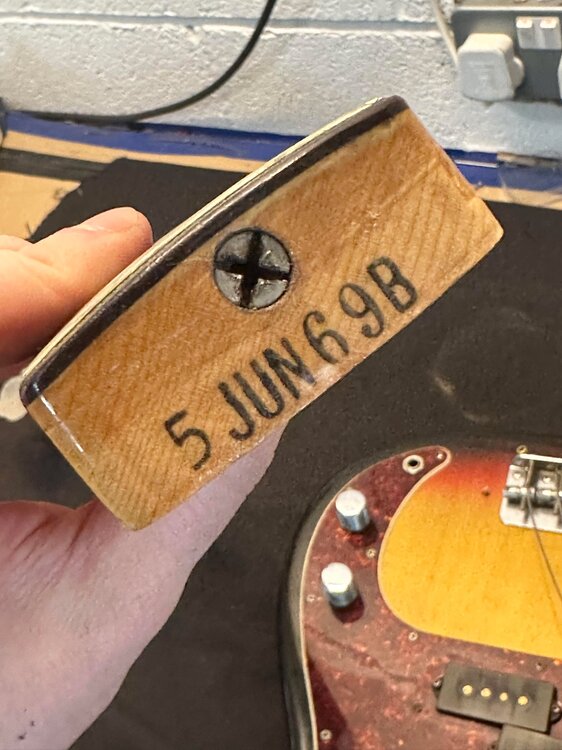 shame about the neck because it's absolutely gorgeous, sure someone could sort it out though and might be worth it for that finish
 -
I didn't read the notes first so I was shocked at how much difference the Super Fifteen was making but that's probably because it's 'to taste'. It sounds by far the best there IMO, but then it might be possible to get somewhere near (or different, or better) with the eq on any of the other boxes that have it. My takeaway is that the Super Fifteen and the Noble consistently sound the best and the Caveman sounds consistently the worst, with all the rest being somewhere in the middle, very similar and moving depending on the bass used. What was immediately obvious though is how they all sound WAY more the same than different. Aint none of these a Sansamp or a Darkglass are they? Caveat: Youtube compression.
-
If we are talking modern class-d amps, I suspect that someone in the industry, probably an accountant, has decreed that 200w gives the best bang for your buck in an entry level bass head ( or combo). The amp designers also probably agree that 200w class-d should be just enough to gig with in a band not requiring a full blown FOH gig setup. If you take a company like ICE Power for example, the unit cost of a 50w, 100w, and 200w class d module is virtually identical. It's literally pennies of a difference. They are also all roughly the same size so will fit in a small box that needs only minimum peripherals to support them eg small cooling fan that runs fast, I/4 inch jacks and basic EQ and a DI. Would anyone be interested in buying a 50w or 100w class d head when a 200w head is the same cost? Could you gig with a 50w or 100w class d head? Maybe a combo though. Fender's Rumble 100 is a very good example of a successful package and I think they use 100w ICE Power modules into a 4 ohm speaker. ICE Power's 300 watt modules are only marginally more expensive but larger so need a bigger case, more peripherals. When you get to 500w modules, the cost has doubled from the 200w modules. Slightly more peripherals like a larger cooling fan, maybe combi speakons, more features mean there is an increase in costs and that is reflected in the jump in retail prices. At the end of the day cost plays a large part in the proliferation of smaller class d heads around 200w. It's a sweet spot for budget rigs nowadays. It's possible to buy a 200w class d amp brand new for about £90 ( eg TC Electronic BAM200). So these days, class-d 200w, 500w and 800w( 700w with 100 marketing watts added😉) are basically what is generally available to choose from new and second hand. These replace what in the past was class a/b 50-100w, 100-300w and 500w +; where 50-100w was for home/studio use and the pub/club player, 100-300w the advanced prosumer player who could afford it( wedding bands?), and 500w + the fully professional level amp. IMHO of course. I still have a couple of amps that I'm equally happy to use at home, studio, and gig with in the 100w-300w power range. None are class-d, and that's just a personal choice. 🙂
-
Those Abertillery roads/hills are a challenge, especially for handbrakes & hill-starts.
-

Harley Benton flats - they're a bit good!
Stub Mandrel replied to mcnach's topic in Accessories and Misc
Yes. The are pretty accurate, not as nice as my Mitutoyo ones. -

For all you fretless lovers...Sire Sandblasted V7, wow!
Grahambythesea replied to jd56hawk's topic in Bass Guitars
👍🏼 -
Long horrible journey to Abertillery, a mining town where the average road gradient is about 45º. The local Blues club. They were a bit disappointed with an attendance of 80 people at £5 a head, which filled the place and we thought was excellent on such a grim nightn although the venue looked welcoming on a dark night. Bluesfire so LOTS of pa, lights etc. Played from 8:30 to 11+ with a raffle break. Nice little stage and great sound as good ceiling, carpet and plenty of bodies to control the sound. My rig has been sounding glorious since I just boosted a mids a bit. Could barely hear my voice in the monitor though. First time they've only used one sub and to my ears the low end sounded much better. We got a rapturous reception and were more free and improvisational than usual which was mostly fun and occasionally hairy. By the end I felt like I'd been beaten up, so the long slow load out and hour's drive in more rain were tedious. In bed at 1:45. Another gig tonight with Bendricks Rock nearly two hours away. Fortunately singer will drive. I see much ibuprofen in my future. I hope my body copes with this two month glut of gigs.


