

All Activity
- Past hour
-

Advice from Cambridge-based bassists needed!
urbanx replied to TKenrick's topic in General Discussion
I'm not really an 'open mic' attendee, but see posters for them about regularly, actually in town the main ones seem to be: The White Swan on Mill Road - Every Thursday The Alma - Third Sunday Venues I'd recommend to play / meet local bands . musos are mainly: SixSix Bar - The only real dedicated, grass roots venue in the city centre Portland Arms - Dedicated music venue, but just outside of town (crap parking, but well served by busses) -

Fender Jazz MIM 2020 replacement tuners
Martin E replied to ingmar808's topic in Accessories and Misc
Not boring but surprisingly perplexing once you start looking into it - so many different sizes and specs to consider. I replaced the tuners on my MIM Player bass with Gotoh Resolite GB640. Not cheap but made of duralumin, so much lighter, vintage style with long shaft and with a large backplate which will probably cover any existing holes you may have. -
On the one hand, things like the Brassmaster enclosure are silly. But also going too small is silly given what the pedals are used for. It's just asking for trouble having squeezing it all that much with delicate tiny dials and switches right next to something you stomp on. And those red dials and small switches are far too small to notice if they're in the wrong position (especially with this on the floor at a gig). The mini enclosure doesn't even really save much space when plugged in on a pedalboard compared with something like an Origin effects Cali 76 Compact (a well designed pedal enclosure).
-
 Still available? Where in lancs?
 -
For those of the left handed bass playing community. I will have two left handers at the Guitar Show this weekend.
-
Nice one, and a great outcome
-
😄 No problem!
-
Sold out Saturday so just a few tickets for Sunday left
-
Great news that its finally been returned. Nice looking bass too. Dave
-
I’m REALLY impressed with who is the exhibitors are. I’ll see if I can make it.
-

 Hi, is the case still for sale? thanks Don
 -
I'm getting very intrigued by the Monza. I'm typically gigging in small pubs using a pair of BF One10s driven by a Genzler Magellan 350. Despite playing with a reasonably loud drummer I find setting the volume at about 9 o'clock is usually enough. Some previous posts suggest a Monza can replace two One10s. Does my Magellan have enough power for this scenario, or am I going to need a beefier amp?
-
 Someone had better be quick!
 -

Bass shipping boxes + packing - Glasgow
velvetkevorkian replied to velvetkevorkian's topic in Recycling
Off to the big blue bin in the sky, sorry Stevie -
 I bought this Zoom drum machine from Basschat some years ago for some planned home recording and songwriting which never happened, and it’s been safely packed away in my drawer ever since. It’s a Zoom Rhythmtrak RT323 - an early 2000s bit of kit which is thankfully dead easy to use and has lots of very decent drum sounds in it. It’s in exactly the same condition as when I bought it, and it’s never even left the house. Comes with its 9v DC adaptor and a slightly dog eared manual. No box but I’ll pack it up well. As you’d expect there’s a big range of drum kits, percussion and bass sounds, and user drumkits whose parameters can be edited etc, and the ability to create patterns, songs etc etc. It’s worth mentioning that it doesn’t appear to function on batteries (it takes 6xAAs). The connectors are all clean and not damaged in any way, so I’m not sure what the issue might be. I always used it with the power supply, so it wasn’t an issue but obviously worth pointing out. Cosmetically there are a few marks on the metal back plate of it which I’ve tried to show - none affect how it works. There’s a few of these on EBay/Reverb etc for between about £65 to £100 upwards. I’m looking for £45. Happy to post within the UK and I can work out a price to do so. Equally you’re welcome to pop in for a cuppa and to try it out. Any questions give me a shout.
 -
A$$ Back Home - Secrets
- Today
-
I'll be there Saturday
-
UPDATE 25/2/26 At last the bass has been returned to me. It took over 3 weeks since being spotted on an auction website, and I must say the auctioneers weren't very helpful at all, and wouldn't return phone calls or emails. I think the Police getting involved helped. It would have been very easy to find me if anyone had spent a few minutes googling. A receipt was inside the case with my details and the detail (name and address) of the person it was going to. I feel no effort was made to find the real owner - and saying it was lost/unclaimed is ridiculous. I'll leave it to the Police investigation to establish if there was any criminality involved, but I feel it passed through several hands before it got to the auction site, and these people had the opportunity to find out who really owned this expensive bass, but no effort was made. Someone was set to make several hundred pounds from its illegal sale. I have drawn my own conclusions..... Anyway, I'm very glad to have got it back. It's caused me a huge amount of stress, time and frustration (mainly stress)and I would like to again sincerely thank the person who contacted me with just hours remaining on the timed auction and alerted me. Also the Basschat community members who emailed Wellers Auctioneers in Guildford. I'm sure this really helped, so thank you. One last thing, the person it was made for has had a change of circumstance and is no longer in a position to buy it (I refunded his money in full as soon as I knew it was missing) which is fair enough, it's dragged on a long time with no guarantee I'd ever get it back. So it does mean it's now for sale, so if anyone is interested pls contact me for full specs and pics etc. Thanks again Basschat members......
-
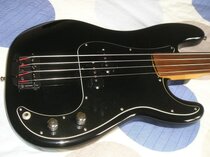 Black MIM P body with a 2004/2005 CIJ fretless neck, DiMarzio pickups and a Hipshot vintage bridge (with quick-loading string slots – no longer available). Strings are Thomastik Jazz flats. Strap pins are Schaller (no strap locks supplied). There are only two points of *very* minor damage that I can find: a tiny ding on the reverse of the head, and a mark on the side of the body (below a point roughly between the tone control and jack socket). There is no indentation, it is almost impossible to see and may well polish out completely. I have highlighted them with red circles in the photos. Will be supplied with the SKB case shown, which is reasonably well-used, but undamaged and suitably rugged. I reckon it’s got to be worth £450 regardless of the mixed-parentage, and would want another £75 for the case. Shipping is likely to be around £25, so £550 in total. Anyone prepared to view/collect from Barnstaple by arrangement can obviously forego the case and shipping costs.
 -
 I'm after a pitch black and local, so please give me a shout if you'd consider splitting them up.
 -

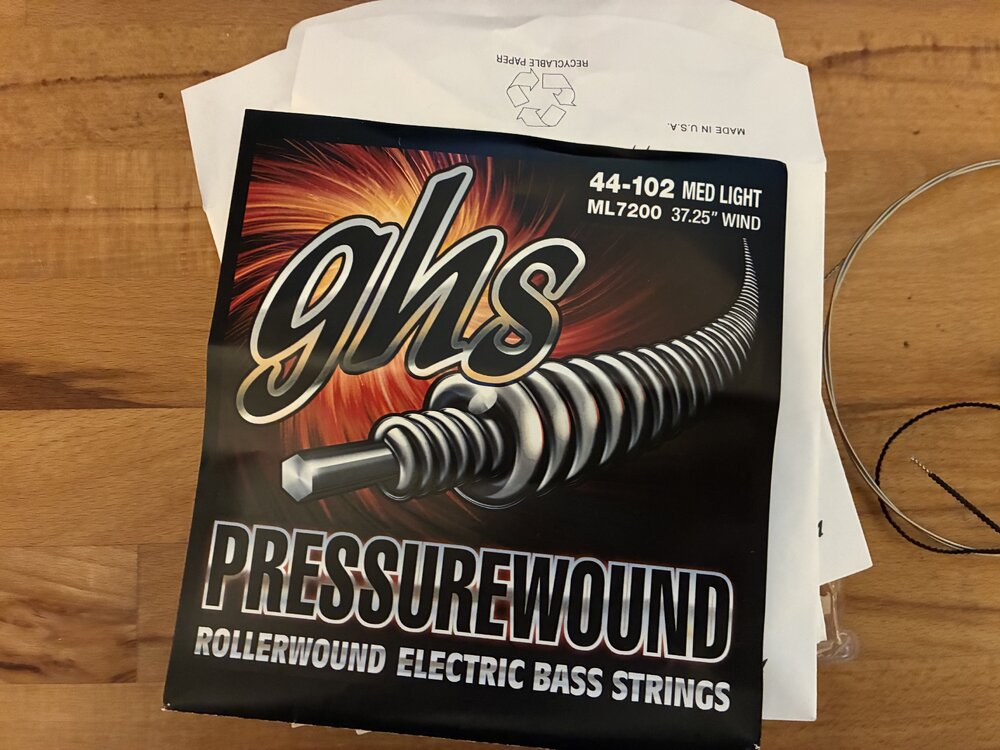 GHS Pressurewound medium/light 4-string set for sale. Tried these on a recommendation, but they're just not for me - the sound and general feel is great, but I just don't like the stiffer hex cores. The A and E strings have been trimmed slightly to be strung on a 34" scale P bass, but they were only on the bass for a day max. If anyone is curious, they sound like played in nickel rounds to me straight out the box. Looking for £20 posted in the UK if anyone would like to give these a go. Cheers!
 -
Like an amp that goes up to eleven?
-
It was the pasadero ( lounge?) bar in the town centre.Fairly local to me aswell, only live in Horsham. Ok will do x
-
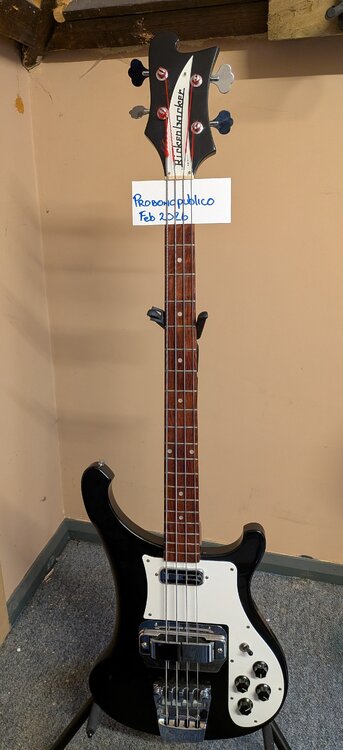 This is the next part of the wind down and realisation that I will not be Bruce Foxton, Chris Squire or Geddy Lee. It was purchased from Bass Bros in August last year whilst mourning the sale of my Fireglow 4003. The production of these basses began in the ’80s and the V63 is the forerunner to the C64. This bass dates from 2000. It was based on the 4001S basses used by McCartney and Chris Squire, and features no binding, dot inlays, a toaster neck pickup and horseshoe bridge pickup. This bass is in great overall condition although it has a couple of dings on the lower bout and headstock which I have captured on the photos. Original hardcase included. It plays great and is currently wearing a new set of Rotosound round wound. It came with a set of flat wounds which I’ll include. It’s not been gigged or taken it to a rehearsal since I acquired it and it’s never left my music room. It has the original silver Rickenbacker case with keys. It weighs 9.7lbs. The price includes mainland UK delivery. This will see my collection down to 2 basses.
-
- 4
-

-
Oh yes, I wasn't blaming AI for that, its just another nail They did and it put some people out of work but it was also very expensive, so not many!




.thumb.jpg.479e4b8ac1d6260ac96cab0b087238e1.jpg)


