All Activity
- Past hour
-

If you were starting today, what’s the best way to learn?
TheLowDown replied to Useless Eustace's topic in General Discussion
I wouldn't think so because you're still learning the same instrument and the same techniques. If anything it will probably make you more flexible in being able to adjust. -

Sir Horace Panters “Ghost Town” Precision Auction
Misdee replied to Lozz196's topic in General Discussion
My point is that, never mind ten years from now, it's already not worth twenty grand to a sensible person of any generation. It probably never was. Who is so emotionally invested in the summer of 1981 that that are willing to fork out that much money for what wasn't even Horace Panter's main bass? Does anyone actually believe that this refinished P Bass was in fact Excalibur in the war against Thatcher? Is anyone that daft? -

If you were starting today, what’s the best way to learn?
Lozz196 replied to Useless Eustace's topic in General Discussion
Well as I learned on a short scale bass, though didn’t know it at the time, I can’t see any problems in doing so. -
I have used - tuning forks (A, C) - records - other instruments - various electronic (quartz) tuners from a watch to bigger units (KORG Master tuner for double bass, Peterson SAMS at home) My all time favourite is an inexpensive Ibanez MU40 (tuner metronome). A small, gold coloured package. I have one in a mono single, and another in a mono dual case. My basses stay well in tune. I don't need (or even like) pedal metronomes.
-
 Is it a bad idea to practice on a short scale bass? I bought a little guitar & bass years ago when the kids were little. The bass is a Stagg, probably Chinese. I always thought it was a toy. Since reading this forum I now know it’s a short scale bass. It’s 30”. It’s actually quite nice to play. I’m planning to get a cheap bass that’s a bit bashed that I can leave round the house, but for now I’m practicing on the little stagg.
 -
Ok after some back and forth with the seller i got shipping down to just £30 for DPD economy, so £110 of his listed shipping cost! NBD incoming....
-

Column/Array systems - small band
Suburban Man replied to andybassdoyle's topic in PA set up and use
I think that if you want to get creative you can separate the Maui columns from the bass speakers with 4core speaker cable. You obvs need stands for the columns but it gives a lot of flexibility to the stage setup and allows best use of the column sound dispersion. -
 ^^^^^^^^
 -
I don't see any basses on that settee. 😂 Mark
-
Bloomin luvverly. Your recent posts are re-igniting my inner Ric, Clarky.
-
I have a couple of LD systems amps for PA use - they are fine in that context, but I’d find the fan noise too much for use as an instrument amp
-

How do I block individual users?
Minininjarob replied to Minininjarob's question in Site Issues and Questions
I meant I couldn’t find it before you told me where it was! Thanks for the help. -
They must be a bunch of fine musicians to play Steely Dan numbers 👍
-

Sir Horace Panters “Ghost Town” Precision Auction
Mickeyboro replied to Lozz196's topic in General Discussion
“ Panter repurchased the instrument and integrated it back into his rig for the remainder of The Specials’ celebrated reunion era (2008–2022).” Bollix. He was playing a Jazz when I saw him on the Encore tour. -
Not been our experience: e.g. we all immediately noticed greater articulation through our IEMs when we upgraded our desk (albeit from Soundcraft-> A&H) and the better quality preamps were a big chunk of that improvement I would hazard?
-

Storing a neck that is not attached to the bass
Jeffskowski replied to Jeffskowski's topic in Repairs and Technical
Makes sense. Thanks! -
That looks the absolute mutt’s nuts!
-
Guess all we’re going to do is to confuse matters! I shall wait to see what the consensus is.
- Today
-
If it was an earlier neck that would make the heel stamp wrong and the headstock logo wrong
-
Brilliant amps, the taste control is a thing of genius. Lots of the H word in these.
-
My first band was mostly a recording band. We had two reed organs with different tones and different preset chords, but unfortunately were out of tune enough with each other to not be usable at the same time. We'd tune to whichever one we were using for each song. For my second band which played live we would all (bass, guitar and other synth) tune to our Wasp synth. This then had to be set up for the first song which had an opening filter pulse which was triggered from a drum machine, but the opening time of the filter was set using the repeat function on the envelope generators. Although I had a patch chart showing the positions of the knobs this had to be fine-tuned to the speed of the drum machine which as set by another rotary control. I could take us up to 5 minutes to tune up and the set up the synths and drum machine for the opening song all of which had to be done with the band on stage in front of the audience. In 1983 my next band with was all synths used a test tone at the start of our backing tape for tuning, which again had to be done on stage in front of the audience immediately before we played. After 3 gigs like this I went out and bought a Boss TU12 tuner and have never had to inflict the tuning song on my audience since. Having said that electronic tuners are not without their foibles. At a Terrortones gig our guitarist had managed to set her tuner to something other than A=440. The sound was terrible on stage so the only person who noticed that something was wrong was our drummer who was sandwiched between the guitar and bass amps. He kept telling me us to tune up which we diligently did, each perfectly in tune with ourselves and completely out of tune with the other. It was only at the next practice where we could hear everything properly that we realised what had happened.
-

If you were starting today, what’s the best way to learn?
Geek99 replied to Useless Eustace's topic in General Discussion
You never finish being a bass player so you’re good to go there 👍 -
It's interesting to compare how 'easy' (I use the term loosely) it is to get started o various instruments... Certain types of instrument are inherently more difficult to make progress on. There's a reason why the recorder is used as a beginner instrument as it's easy to blow and the fingering is simple. The only down side is that for the small hands of children it means using the descant recorder, which is very high pitched. The treble recorder is much nicer to listen to. Here's a consort of recorders from treble to the sub-contrabass... Main challenge with 'standard' recorders is that you need to learn two sets of fingerings for F and C instruments, as unlike say saxes, they don't transpose so you have to use different fingering on the different pitches (i.e. descant and tenor are same fingering, treble and bass are same fingering). Single reed woodwind instruments are relatively easy to get going on. This is the clarinet and saxophone families. Saxes are easier than clarinets. The embouchure is not too difficult and fingering over the core two octaves is mostly straightforward. Clarinets are trickier. I play saxophone and in my first lesson, I was getting basic notes out of it back in 2011. The core couple of octaves of D below treble staff to the D two octaves above are relatively easy to learn. It takes longer to be able to do the lowest notes (down to Bb) and the highest standard notes up to top F#. Double reed instruments are MUCH harder to get on with. The main ones being the oboe and bassoon families. not only are these instruments difficult to play/learn they are also inherently much more expensive. String instruments of the violin family are relatively easy to get basic sounds out of but present challenges of coordinating fingering with left hand and bowing with right. Cello is easier as you don't have to seal with holding the instrument up like violin or viola. Getting to a reasonable standard is more challenging. And that brings us to brass.... I have only recently tried to play a brass instrument and it presents a lot of challenges. You have to maintain an embouchure, similar to sax, but you have to 'buzz' your lips as well. For a given combination of valves, there is a harmonic series of notes that will come out. You have to adjust your oral cavity - mostly by raising/lowering the tongue - to be able to get different notes from teh harmonic series. For example, the base open note with no valves is a 'C', the next harmonic is the 5th at G, then the octave at the C above, and so on. to play a specific note, you have to think about 'pitching' it since even at my basic level, 'open' (no valves) can produce one of 3 notes depending on how I pitch it. The number of choices will increase as I improve. Using valve 2 will give me the B below middle C, F#, then the B an octave up. I've been playing since the end of last September, initially with weekly group less with the band, I now have a weekly private lesson. I can just about play from B below middle C to the C an octave above, so a 9th. Apparently, that's about what you expect for someone that's been learning for a year. Admittedly I have some advantages in that I already read music so do not have to add that into the mix.
-
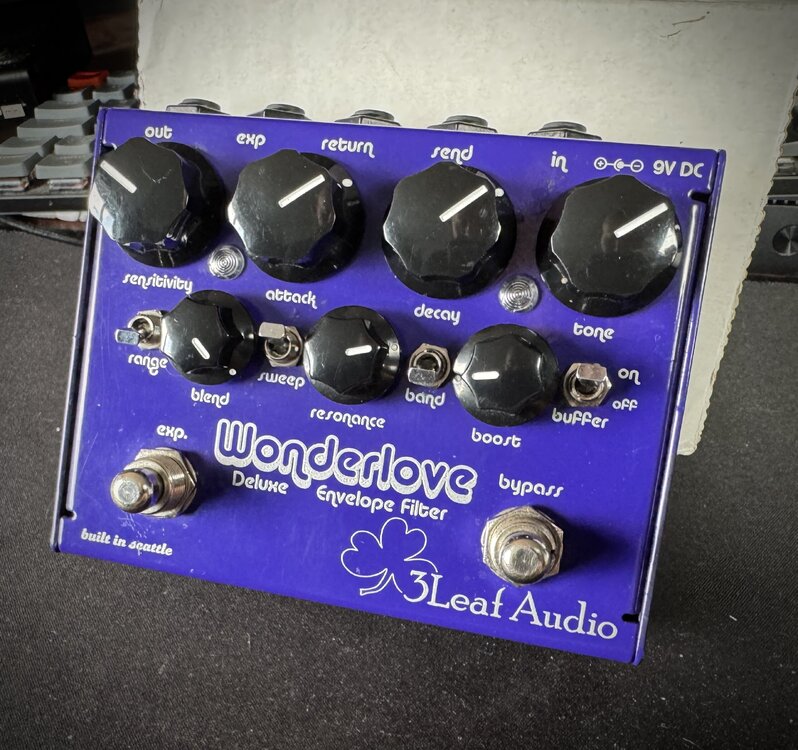 3 Leaf Wonderlove... having not found a new owner for my Proton, I've decided to put it into use but can't have two 3leaf filters sitting around. This one I prefer considerably, but it's not quite as pedalboard friendly. Knowing my luck with selling 3leaf stuff the asking price for these will be a grand within days of me letting it go (see original proton, octabvre Mk3 🤦♂️) This is the deepest, wahiest filter pedal I've ever had and the routing options are very useful. Boxed, Price includes speedy, tracked UK postage.
-
- 2
-

-
Most likely @Mrbigstuff got it right with a 4 bolt neck refinished. worth checking the underside of the neck to see if there was ever a 3 bolt fixing (I’m guessing not!)