All Activity
- Past hour
-
Music Store, and ordered the £12 midi cable at the same time to take advantage of the free delivery when bought with the pedal so £317 all in. Oooh speaking of which, that's another extra for £20 that the FI has over the MXR, I'll update my list!
-

Your best (and worst!) bass gear purchases of 2025?
Stub Mandrel replied to Al Krow's topic in General Discussion
Indeed, it's just intuitively I'd expect all FRFR cabs to sound the same, but many sound utterly lifeless and the Monza doesn't. The answer is presumably that not all FRFR cabs are created equal, or even truly FRFR. -
I think the Levy's one is meant to be used with a female to male extension lead. The bug plugs into the female jack and sits in that pouch then the lead plugs in as per usual. You just need to make sure the lead is the right length.
-
Does he mean "use a time amp! = Essential!" or "use a time amp != Essential!" as the two have opposite meanings[1] and you need to be sure the space is in the right place, which, given his failure to write "your" instead of "you're", seems only about 50% likely. And are time amps going to succeed tonewoods as the next big debating point? Can you get timewoods? [1] They do to a programmer anyway
-
Your best (and worst!) bass gear purchases of 2025?
Stub Mandrel replied to Al Krow's topic in General Discussion
I like the sound of my GRBass AT212; in a shootout with a Monza it was generally felt it sounds slightly scooped by comparison, bit not far off 'flat'. Both sounded good with a various types of music played through them, and obviously sound great with bass played through them. I have a number of inexpensive all-in-one cabs that sound fine for music or when used as low powered PA that would probably be considered as FRFR (or meant to be). My cheap reference mic suggests they are a bit short <100Hz and above 11 or 12KHz and wander up and down by about +/-5 dB across that range (partly due to me measuring in a living room, I suspect). They sound weak with bass through them, if detailed, and an IR cabsim transforms them. I suppose I ought to (1) see if I can measure the response of my GRBass cab and (2) see what happens if I power it via the Cube Baby. -
 I’ve had these in my string drawer for ages and would like to know what they are! I had the Rotosounds in the dim and distant past and recall they had yellow silks….but that was ages ago. Could they be La Bellas? The tension is very pleasant. Any help would be appreciated.
 -
I've been eyeing it up too (helps that it has just been payday!). Did you order it from Music Store or direct?
-
I think they wouldn't need to necessarily reinvent the wheel with captures. If they just included a NAM block, that would probably be enough. That's all the Anagram has done on the capture side. Hiring a UI designer would be a great help, and yes, the apps are all a bit shocking. The load time from selecting the patch on my GX-100 to showing it on mobile/computer editor shouldn't take 10/20 seconds. I don't know what protocol they're using to transmit the data, but it needs to be modernised. I think that they do get so much right with the functionality though, like the options to assign any parameter to any control and the properly seamless preset swtiching. More assigns would probably be on some people's wishlists. Oh, and the wavetable and input assigns to parameters is great too. I personally think that their amp sims do leave something to be desired. I've never been totally won over by them and struggle so much to get them to sound like I want to that I've kinda given up with them. Compared to something like the cheap Sonicake Pocket Master that I've got, where the Twin sounds perfectly useable to me with a few tweaks, the one on my GX-100 just doesn't have the same ease of dialling it in. Adding a good synth would be a good selling point too. And maybe getting all of the effects from the Plugout might be a USP for them? Give it all to the users of the new gen pedal.
-
Subdivisions - Rush
-
 Nice price
 -
Well, actually no, and that is where a misunderstanding as how LLMs work, which is quite common really. I am a software engineer, and where I don't have to worry too much about the future as I will probably be dead within the decade, you can't just generate code at the touch of a button (and actually there is no button, it is just autocomplete). An LLM is very good as 'boiler plate' code, stuff you do over an over again, there is a lot of it, and it is good that it farms that out, so it does save time. However, an LLM as discussed here has no inteligence, it just has things it has copied from somewhere else. Its job isn't to solve a problem, its job is to show you 'what a solution to this problem would look like', and that is a huge difference. It is a language process, not a techical process. It doesn't understand the problem, just the overall look of the problem, which is why it is good at language and music. "What would a country song about a clam sound like" is an appearance issue, it doesn't have to know about what a clam is, or how it feels about anything, or why it cares about its truck breaking down or its dog dying. When I first used it it made a complex function which seemed perfectly to do what I asked. When I looked closer I realised it would come out with the wrong results, but it is very hard to spot, and AI can't fix it because it doesn't understand how it works, just how it should look. Its shown really clearly in the 'how many rs in a raspberry' problem that chat GPT had. AI isn't writing about something, it is writing something that it thinks a song should sound like, and for 95% of music that is enough, and it probably will kill a lot of music just because people won't be able to have it as an income, because for a lot of people that sort of music is enough, meaning ultimately music will go back to a niche hobby, like it was in the past, somthing people did for themselves, not for profit, like the guy on the piano in a pub.
-
Which bass?
-
With four magnets that's more than a kilo.
-

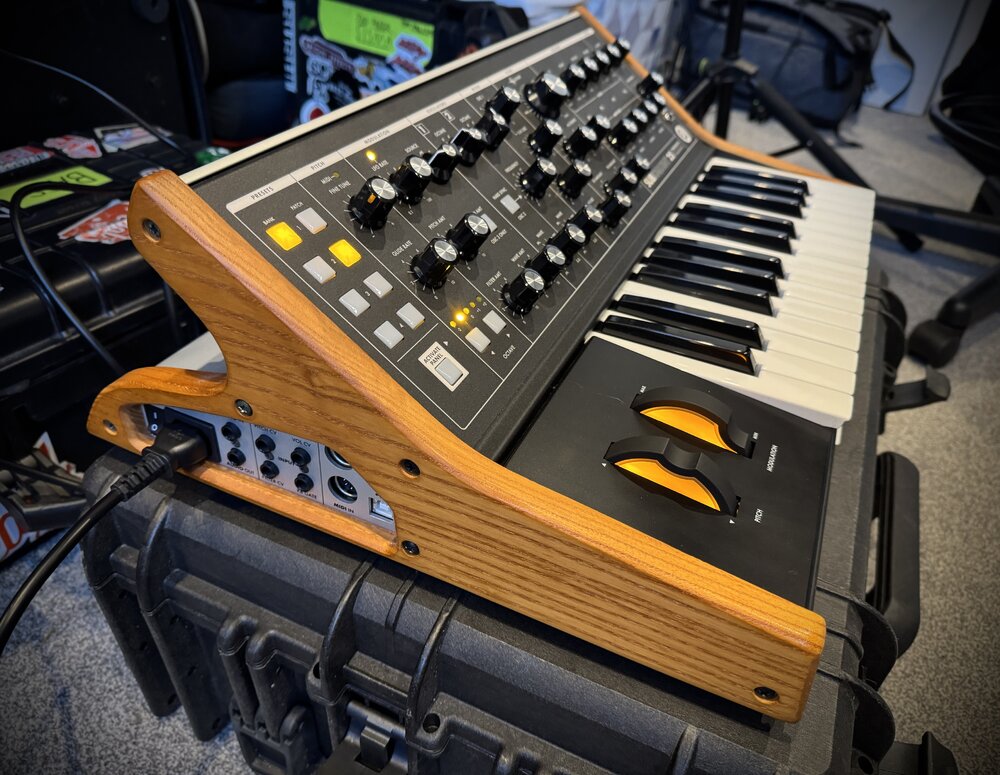 I’ve always wanted one of these! Unfortunately having a grandmother and minitaur , means that I’ll have to pass . Have a bump anyway ! GLWTS
- 1 reply
-
- 1
-

-
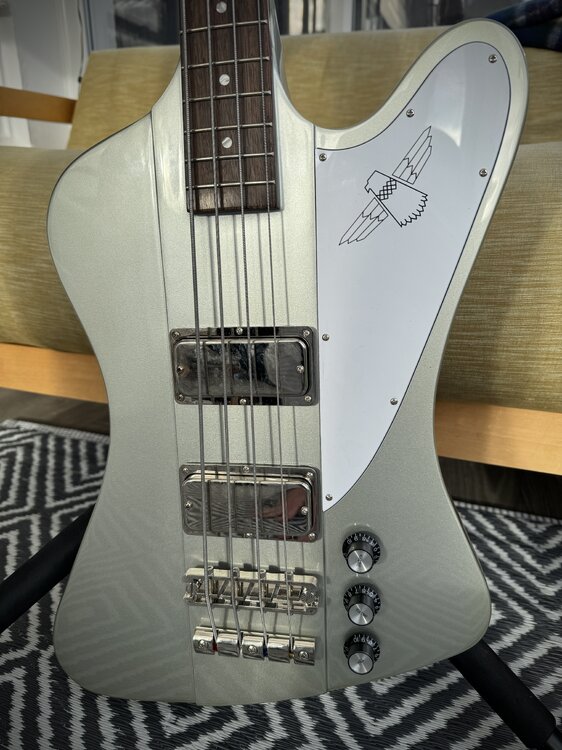 Given the nature of the Bird... I'd prefer collection/Delivery but well packaged and very insured postage is possible. This one has been my gateway drug, and before i knew it i've bought myself an old single pickup model. It's in mint condition, and comes with a great padded gigbag. Pretty light at 3.8 kg, and personally I haven't had an issue with neck dive as these sometimes suffer from. These are proper neck-through models like the originals. As always please hit me up with questions/photo requests! .
-
- 15
-
-

Monty’s Guitars Interview at the BassChat SE Bass Bash with Mike Brooks
Sean replied to Sean's topic in General Discussion
The "Monty's basses" were all partscasters built in house to demo the pickups and were very impressive instruments. Unfortunately, they were "demonstration purposes only" and not for sale. I know that he could've sold a couple on the day, no problem. -
Neighbourhood #2 (Laika) - Arcade Fire
-
I have been successfully using the Boss WL20 wireless plugs for years. They're great. I have recently acquired a sexy new Jazz-style bass with the jack on the front. This means the Boss plug now sticks out perpendicular to the body. My other basses have side mount jacks. It functions perfectly well, but aesthetically it offends me. Has anyone come across a wireless transmitter pouch that will hold one of the smaller wireless transmitters like the Boss? For example, I don't know whether the Levys one will fit or whether the 'bug' will just fall out the bottom.
-
Yeah, I was quite baffled by that one - I'm guessing there's a whole thread to be had arguing whether they work best with analogue or digital clocks... I know, I just can't compete with these levels of credibility!
-

Markbass Traveller Cabs - 102P + 121H
stewartmusic replied to Rowntree's topic in Amps and Cabs For Sale
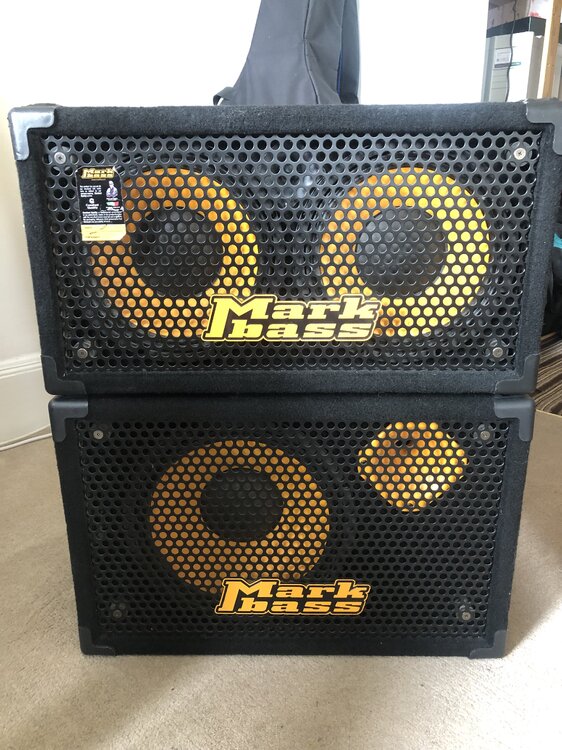 PM
PM -

Your best (and worst!) bass gear purchases of 2025?
tauzero replied to Al Krow's topic in General Discussion
It does mean that you're not stuck with a single baked-in amp and cab sound, you can use different ones by using NAM/IR or other modelling. -
I think there's some nuance that's being missed here. Trained neural nets absolutely have an application in all sorts of areas, and tools that use this technology are often capable of doing things that were previously unachievable - I'm most familiar with the audio world (see stem splitting, reverb matching, etc) but we can lump in things like image uprezzing, spotting cancer, etc. There is no "intelligence" at work here, it's very effective pattern recognition. These tools have undoubtedly made my job easier, and the results I provide to my clients are better as a result. I also very much view keeping up with the latest and greatest tools (assuming they are, in fact, the greatest, rather than marketing hype) as worthwhile professional development. Generative AI, however, is a wholesale power grab of creative outputs by corporate forces (the creative inputs were provided by anyone who's imagery, writing, music or audio were part of their training data, whether they consented to that usage or not). To me that is very different from a "tool" - it's handing over the reins of creative production to the rentier class. Who stands to capture the value of this? There are reasons to be optimistic, however: Most creative people want to work with other creative people. I respect talent, and the creative achievements of my colleagues are what make it worthwhile. So I think the creative industries will persist in a different (perhaps diminished) form. Part of adapting to the new reality will be forming networks of likeminded professionals. Despite the constant noise that AI is going to take over everything, some more-intelligent-than-me computer science types believe we're already at the point where models won't get much "better" at stuff. There simply isn't the volume of training data available, or the cost of accessing and processing that data is too high. There future may well be in faster, more efficient, more targeted models that swing back to special purpose tools. AI generated output is rapidly becoming a marker of low effort and therefore low value of the resulting product. Or do you buy all those scammy lifehack products on AI generated YouTube prerolls? Even with gen AI not everyone can be an effective art director. We're due a massive market correction once the circular accounting between the AI pushers and Nvidia reaches critical mass. As well as wiping off a huge chunk off everyone's stock/pension portfolio, it will be the morning after the night before for the AI optimists.
-
I feel your pain guys, but I've engineered a very simple GAS-management rule now, I only own basses that have Fender compatible 4-bolt neck construction. Basses that arrive in my place cease to be basses, they become donors. There's two real benefits, some necks just sing with some bodies, and it's interesting and satisfying to go through that journey, and I can beat the urge for a new bass by simply swapping around a few components. I've about 4 fretless and six fretted necks, and around 10 loaded bodies (Precision, Jazz, Tele, Jag). Obviously neck-through basses like that in this thread rather mess things up, which is one reason I wouldn't chase it again if it came up for sale, no matter how lovely it was, same with the BB2024MX 👍
-
A lefty friend I know He sells some really nice bases
-
This is something which occurred to me recently and which may well not be novel or clever, but I found it useful to think about. At jazz jams we try to run them so that the material played is fairly standard, as we'd like to encourage new players to get up and have a go. Nevertheless, anything could be played if someone brings a chart for the rhythm section and, if necessary, lead sheets for horns. Despite this we do get people who do some or all of: - Don't have charts or the ones they have aren't much use (see below). - Can't explain the form or changes to the rhythm section, sometimes saying "just listen"(*) or "just watch my left hand and work the chords out" etc. etc. - Drop or add bars/beats as they please. - Change tempo unexpectedly. It's tempting to think that they are simply bad musicians, but they sound good when playing their own material and are able to get gigs which I am sure their audiences enjoy. So, I think it must be some sort of cultural difference, specifically that I'm thinking of things bottom-up and they're thinking top-down. For the bottom up view there's a set form and a set sequence of chord changes which the rhythm section will lay down. The singers, horn players etc. can add their stuff on top but they must follow that underlying structure. They could perhaps push or pull slightly against the beat, or substitute some chords, but the form must be respected. For top-down the lyrics and melody are the defining part and any accompaniment then follows whatever the singer (or perhaps instrumentalist) is doing - strumming an acoustic guitar to underpin one's own signing would be a good example. The sort of charts which consist of the lyrics of a song with some simple triads and occasional dominant chord written alongside are not much use to me, as the form is not clear in them, but I think they'd make total sense if thought of from a lyrics/melody-first perspective (presumably why acoustic-guitar-strummers use them heavily). Does this seem at all reasonable? If I'm not barking up the wrong tree, suggestions on how it might be easier to work with the top-down people when they turn up are welcome. (*) Of course, at some jazz jams one might be expected to "just listen" without charts but then I'd expect the tune to be a known structure and get some clue like "It's in Bb, AABA form; A sections are 12-bar Bird blues and B sections are a rhythm changes bridge" shortly before the count-in.