

All Activity
- Past hour
-
Good question. Spec sheets are simplistic guides for what an average designer might expect to achieve when designing around it, but there are a lot of specs that are not on the spec sheet because they become more application specific and depend on the skill and experience of the designer in order to exploit more performance. For example, one of ICEPower's older module families did not specify 4 ohm BTL operation and in fact warned against it, yet in spite of all the other manufacturers who had no first hand experience with the platform (and end users with even less knowledge and experience) expressing their doubt and prognosticating that it couldn't possibly work, that the amps would blow up by the thousands, I developed a pair of simultaneous technique that we at Genz Benz/KMC received a patent for that allowed this module family to work without any issues (performance or reliability) into 4 ohms BTL. I worked with the engineers at ICEPower to validate the design (so that our contract could include ICEPower's warranty of an off sheet application), and we built close to 10,000 amplifiers using this technique and have had way LESS issues than other manufacturers attempting do do this their own way once they ran into the patent. These amps are now approaching 18-20 years old, and through my factory service program I replace maybe one or two power modules a year (less than 2% of amps serviced under this program need new module). This IP transferred over to Fender when we were acquired, around the same time that Fender introduced the Rumble V3 series. This is similar to how we obtain a 2 ohm rating on all of the Subway 800 models, 2 ohms was an off-sheet application that required design validation in order for the modules to be covered. Again, well over 10,000 amps with no problems. This is not accidental success, it's the result of understanding to a very deep level the underlying technology. Making a mistake in this sort of application can be very costly, in fact it can ruin a company, that's why we analyze and test and test and test... I typically use the 10% THD threshold in most of my bass amp models because there are elements and techniques that I use in both the preamp and power amp circuits to emulate various aspects of pre and power tube performance. Since tube circuit performance generally includes the addition of harmonic components (the particular harmonic series that's generated varies depending on what's being emulated, the pre and power tube emulation is different too), these added harmonics show up in the output measurement as THD. Most players seem to prefer somewhere between 5 and 20%THD when driving their amps hard (towards rated power), so I chose a mid-point value that represents the average player's sweet spot. This agrees with the experimentation we did when using a Bass 400+ and allowing a group of players to drive the amp where they felt it was in their sweet spot, and it was all in the same 5%-20% range. This is exactly why there is a notation in the specifications that the THD number in the rated power spec includes preamp AND power amp, the rated power is with full context, it can't be separated out.
-
I have thought of selling it previously but I can't bring myself to let go It's the most idiosyncratic instrument I own
-
Maybe it's as simple as popping the "hood" on your modern class D amp of choice, checking out what kind of class-d module is fitted and comparing the amp manufacturers specifications to the module manufacturers specifications? Not that I'm advocating breaking the warranty seal on your fave amp to find out. As an example, and one I'm familiar with, the ICEPower 300AS1 module is quoted as 300 watts RMS @ 1% THD+N into 4 ohms , 20Hz-20Khz. Curiously, if you tab down on the data sheet they also say the same module will output 380watts @ 10% THD running at 4 ohms. If you tab down some more, they say the same module will output 450W at 1% THD+N, 2.7Ohms. There is plenty of room there for marketing to do there thing with regard to output watts. In the interests of longevity and reliability, I suspect the 300watts rating is nominal and probably the most honest output specs the module can achieve in real world applications and use without a high failure rate. I own an amp with this module and it's sold as per the ICE Power 300watt rating which I feel is reasonable and accurate. It feels like 300 watts at 4 ohms with no weak wattage. @agedhorse is probably in a unique position as a knowledgeable designer to give insights into how off the shelf amplifier module components and specifications translate to real world performance in products he has had a hand in designing. I'm Assuming Mesa doesn't use proprietary class-d designs like Markbass do? It would be very interesting as an example to have an insight in to how the subway class-d product output power ratings were specified and the technology they use... eg the D350 and the D800.
-
Didn't we all - cool bass! I wish I still had mine!😄
- 11 replies
-
- 1
-

-
- 80s basses
- trace elliot
- (and 8 more)
-
Yep - Our first ad was the London/Los Angeles "postcards"-type ad. Memorable indeed! The Lane Poor bass was certainly something different! But hey, it was the 80's!
- 11 replies
-
- 1
-
-
- 80s basses
- trace elliot
- (and 8 more)
- Today
-

What's the going rate for Stingrays nowadays?
Musicman666 replied to Supernaut's topic in General Discussion
my 90s stingray that i bought new is so solid and well made, i would pay more that 1000 for it secondhand today, it plays so nice just like when i first got it...i did swap the neck out for a graphite but that was driven by pursuit of the ultimate rather than any dissatisfaction with the original. -
 If only it had another string! GLWTS
 -
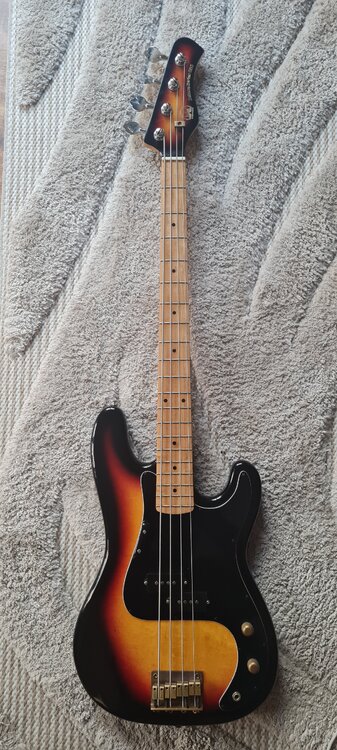 For Sale My Hondo Deluxe Series 830 Precision Bass Dates from late 70s to early 80s Maple Neck and finger board both in good condition no issues Bodywood Unknown Tuners look and work perfectly Has a Solid brass bridge and string stay The bass plays and sounds great and has that old school sound Weight 4.55kg Prefer Meetup or Collection
-
- 2
-
-
Island in the Sun - Alcatrazz
-
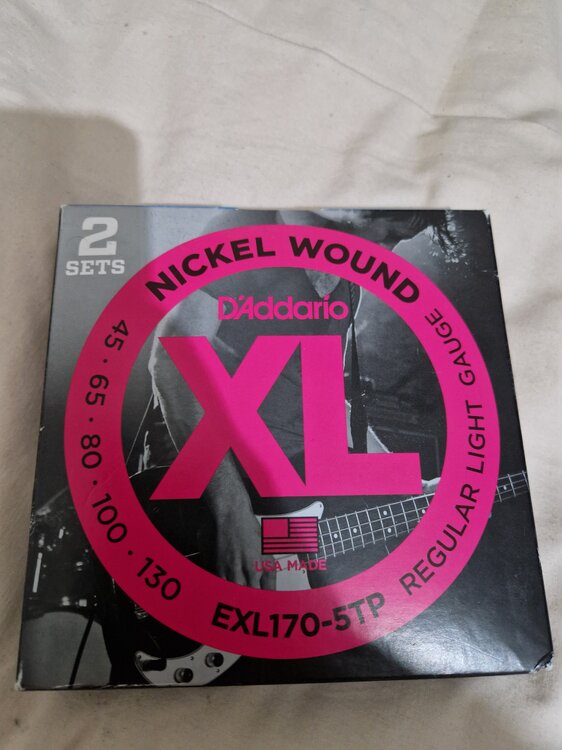 Bought for a 5 string that id borrowed for a gig and didnt end up needing. Im also leaving my 5 string hunt for now as ive seen a 4 i want 🤣 Brand spanking new, still sealed in the packets (I did use the players code though) 2 two sets of 130- 45 gauge. £30 incl UK only delivery
 -
100% the Yamaha. The Franconia is, I believe late 70s, early 80s. It's niche, quirky and very much a collectable or enthusiast instrument. Pickup spacing is unconventional too. @Bassassin will undoubtedly be able to shed some light on Franconia basses.
-
I got my L2 Steinberger in the early 1990's - I thought I had made it!!!
- 11 replies
-
- 1
-
-
- 80s basses
- trace elliot
- (and 8 more)
-
I remember your advertisements in US Bass Player Magazine was like a different world the melting Lane Poor in particular
- 11 replies
-
- 1
-
-
- 80s basses
- trace elliot
- (and 8 more)
- Yesterday
-

 Pickups sold, last few bits left, will do a good deal if you buy a few.
 -
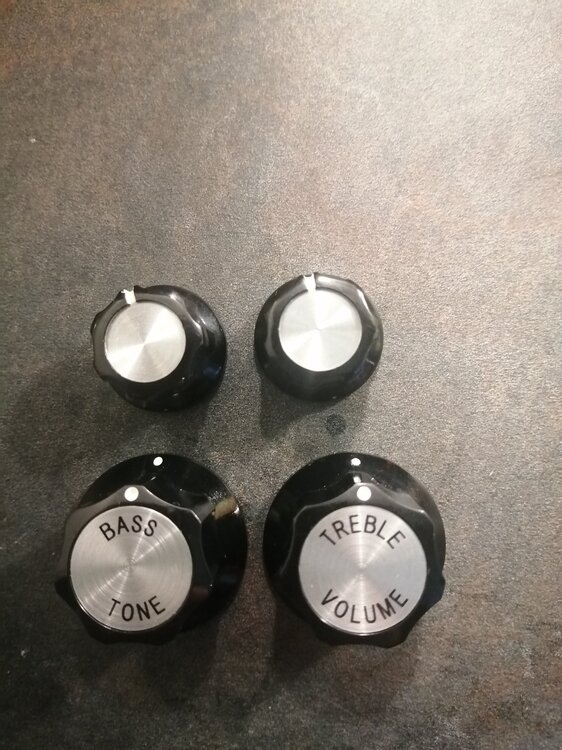 I acquired these with another bass a while back, no use to me. Nice retro knobs. Pick up Leyland Lancashire or will post for £5.
 -
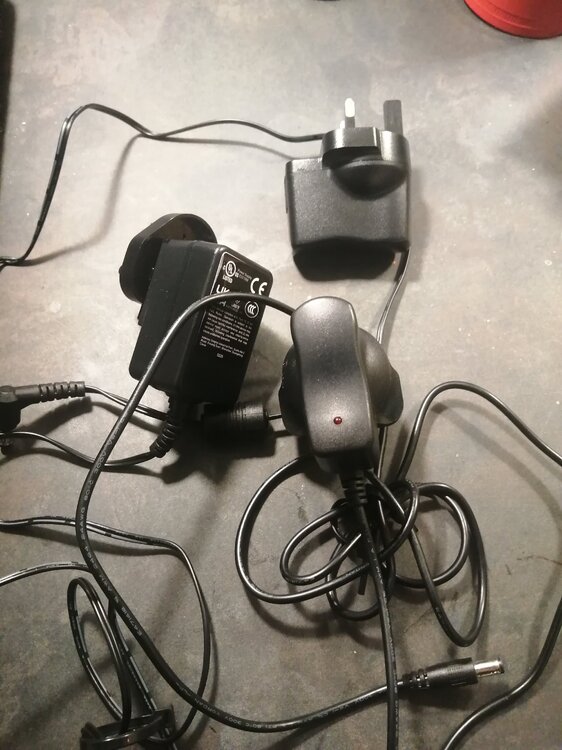 3 power supplies. 2 previously used for bass pedals. I used it for a tonex, zoom ms60b+. The third one is a USB one, great for the new pedals which take USB or charging your phone mid gig. £19 delivered.
 -

2 bass straps
la bam replied to la bam's topic in Accessories & Other Musically Related Items For Sale
-

Further DROP: Markbass EVO1 Dual channel head + carry case
itsmedunc replied to Marc S's topic in Amps and Cabs For Sale
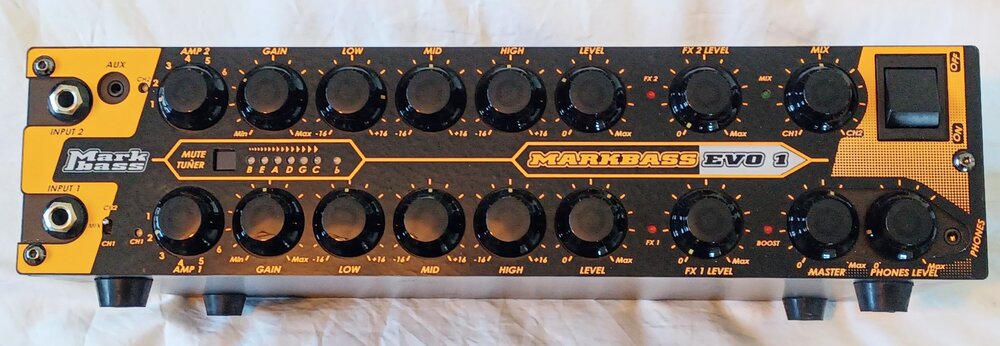 Great twin channel amps these. I use one myself. Amp emulations, tuner and programmable effects. All you’ll ever need really. GLWTS.
 -
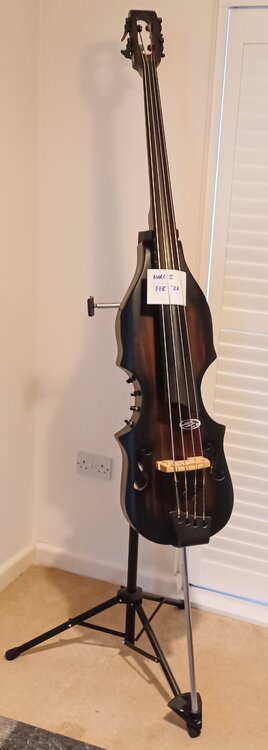 The "hole" near the attachment arm, isn't a blemish.... it's for adjusting the neck angle. I should have mentioned in my first post, that the necks on these are removable, for packing down smaller for taking on tour / air transport etc. But the beauty of the system is that you can finely adjust the neck angle to set up to your preference, and it's really quick & easy to do.
 -
I hate listings where the instrument has clearly seen serious tinkering, but the seller doesn't make any effort to explain (or sometimes even acknowledge) what's been done. Like, you'll see a 1970s Fender Precision with a mudbucker at the neck, some other mystery pickup at the bridge and a Chernobyl-Control-Room number of knobs and switches, and the listing will just say something along the lines of "1978 P-bass, modified". It always just makes me think that either it is completely buggered, or it fell off the back of a lorry and the seller doesn't know what it is.
-
Islands In The Stream - Dolly Parton & Kenny Rogers
-
Poor thing. I feel for it.
-
Gear: Sire P10/ Fender AVII 1960 P ---> Lekato WM80 ---> main effects were SpectraComp on Captain East, Joyo XVI (for Uprising), Mojo Mojo, 80s Ibanex Chorus, LPF ---> Orange Bass Terror ---> GR Bass AT121 slim.
-
Island In The Sun - Weezer / Harry Belafonte
-
Well that was bloody awesome. We got to the Earl Haig early, to find two big projector screens up for the rugby, but didn't affect us setting up. Used their (big) PA with our desk, spent a lot of time with everything miced up (me post-preamp DI'd). Sounded awesome but with the stage volume was comfortable with no earplugs. About 20- people stayed on from rugby and we had at least 120-, maybe 150 people in. It can feel a bit empty on a Sunday sometimes, even with a crowd, but not today. Lots of musicians and music lovers in, including my brother, some of my friends and members of two of my other bands. First half, mostly straight classic rock, so no dancing but rapturous reception. Brief beak, then second half, still rocky but some more danceable stuff, so dancing from about 1/3rd through. You'll get the gist if I say our encores were War Pigs and Alive, and the song that got the most comment was Devil Woman. Afterwards, people were queing up to shake hands and say how much they enjoyed it. We did get (very gently) told off for going 20 minutes past curfew 😁 Baz was taking photos, so I expect some awesome shots in due course. Devil Woman.mp4


