



Mediocre Polymath
-
Posts
223 -
Joined
-
Last visited
-
Days Won
1
Content Type
Profiles
Forums
Events
Shop
Articles
Everything posted by Mediocre Polymath
-
I remember seeing that finish on an old "Thor Sound" guitar in a local shop a few years ago. It does look really neat. I'm always tempted to try that sort of solid/natural finish on one of my own builds.
-
I'm tempted by the PBM. I have some informal gigs coming up where it would be really handy to have a gig-bag-sized amp. It's pricier than others like the TE Elf or the Warwick Gnome, but I should probably put my money where my mouth is and support UK businesses trying to actually make stuff. It also looks like it could be used to hammer in nails or defend against bear attacks, which might be handy.
-
Depends if it's new wood (an offcut) or something recovered during some demo work (like a bit of joist from an old roof). If it's new, then it's most likely Red Grandis (Eucalyptus), which is a plantation-grown hardwood. It looks a little pale for Grandis, but then phone cameras can be finicky when it comes to colour. I've not seen it used in any production guitars, but it's nice wood – dense-grained but light. I use it for the cores of multi-laminate bodies like this guitar: If it's not new then it could be almost anything. Best guess would be – as others have suggested – some form of mahogany, probably sapele.
-
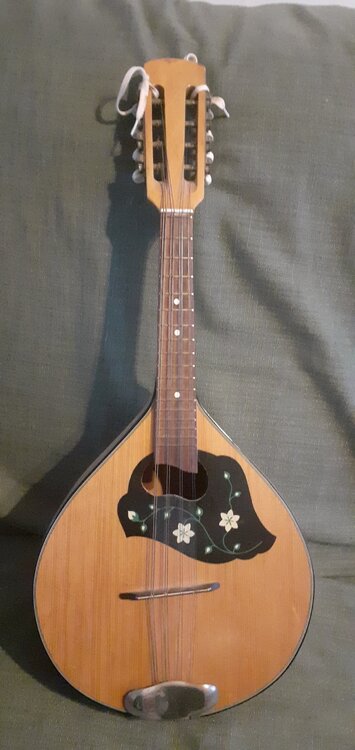
Reviving an East German Mandolin
Mediocre Polymath replied to Mediocre Polymath's topic in Other Instruments
Thanks. There is a lot of glue in the channel, but I don't know if it's actually gluing anything to anything – I can't imagine titebond does much for carbon fibre. The rod is primarily held in place by being smushed between the neck and the fingerboard. -
Not a bass, so I figured I'd put this here rather than in the repairs/build-diaries forum. The weekend after New Year's I headed out to the countryside to collect this old East-German mandolin from @bass_dinger. I've been a mandolin dilettante for years (family of folk musicians) but I've never had my own one, not really. (I have an electric mandolin I made out of offcuts while working on something else, but I don't play it much). I figured the price was low enough to be worth a punt, and it seemed like whatever work it might need would be well within my skill set as a luthier and tinkerer. (Please excuse the cat, who wanted to be in my picture of the action). As fairly described by Robert, the neck was pretty bowed and the fretwork worn down. It was never a fancy instrument and it had lived a long life. I put in an order with my luthier supply shop of choice and set it aside. The following weekend, the first job was to take the frets out. I sat down with my special ground-down end-nippers and started the painstaking process of levering them up. No pictures were taken of this process because it only took about a minute. It turned out the tangs on the frets were not only 1.5 mm deep at most, but also completely smooth – no nibs, no little spikes. I could have probably lifted them out with my fingernails. I clamped the body into place and prepared my special heating tool. This may look like a crappy old clothes iron, but I promise it's a high-tech piece of equipment. I used a pallette knife to get under the fingerboard after it was good and hot and pinged the whole thing off, perfectly intact. I then routed a channel and stuck a length of carbon-fibre rod in there. Not the neatest job because my router plane was being difficult and it took me a while to remember the quirks of the adjusters on that particular tool. Fingerboard clamped back on with the rod in place. The rod is the same size as the one I routed into the (thinner and longer) neck on my electric mandolin, so I'm confident it will hold things straight for the foreseeable future. If I'd been more inclined to take my time with this, I would have spent a few hours planing a backward angle into the fingerboard (it's pretty thick and the neck is dead flat to the front of the body, which isn't great). I decided I couldn't be bothered – if nothing else, I explicitly don't want this instrument to be loud. I had to recut the fret slots because even the finest fretwire I had to hand was much chunkier than the stuff that had come out. I didn't take any pictures of the fretting process – just imagine someone smacking an instrument with a nylon-headed hammer for half an hour, swearing the whole time. Here's the finished job. I recut the nut and bridge slots, and reshaped the bridge a little, but left it otherwise unchanged. As you can see, the action has come down a lot, and the fretwork is now level and even. It plays beautifully and I've already lost several hours to noodling around trying to remember various fiddle tunes. At some point I'll replace the dot markers that melted during the heating process. It sounds like, well, like a £40 mandolin – which is what I expected and what I was hoping for. A fun thing for plinking away at on the sofa and during teams meetings (pro-tip! A mandolin can be played without showing up on the laptop camera if you hold it down low).
-
Indeed. I used to have a late 1980s Yamaha that had a similar recessed panel thing.
-
I just saw that Ancoats Guitars are gearing up to start making basses. Rather nifty looking things. I've been seeing this company's guitar designs popping up on social media here and there, and they look interesting (though I've never played one). They're a small custom builder in Manchester, I think, with a very agressive pricing strategy (basses starting from £1k, which barely gets you new strings these days).
-
Your best (and worst!) bass gear purchases of 2025?
Mediocre Polymath replied to Al Krow's topic in General Discussion
I've had a pair in a little metal container on my keyring for years. Used them only a handful of times, and never felt like they were particularly essential. Then in November I went along to a gig at Alexandra palace and the support act had the worst sound mixing I've ever heard. They were this absolutely dreadful techno/metal hybrid duo, just two guys and a lot of pre-recorded synth stuff. They sounded like they'd gone to the sound guy's desk and just pushed every eq slider from 30 Hz to 200 Hz all the way up. It was just a wall of punishing mush. It was the first time I've ever been able to clearly perceive a sort of standing wave – there was a point near the back of the room where the bass was reflecting off the wall and creating a nauseating out-of-phase throbbing effect. My ears started to hurt immediately and so I popped in my earplugs. It was such a relief. I was the only person from the group I went with who wasn't half-deaf by the time the main act came on. -
Trace Elliot - Rescue & Restore (and bargain finds)
Mediocre Polymath replied to SimonK's topic in Amps and Cabs
You jest, but that is a thing. They're called the Olllam and they're a great live band. Only time I've ever heard a crowd cheer the Uilleann pipes coming in like it was a bass drop at a rave. -
Soldering Iron Recommendations
Mediocre Polymath replied to PatrickJ's topic in Accessories and Misc
Agreed on the Hakko. Downsides are that it looks like it was made by Fisher-Price and that it has a two button interface that makes the even most inscrutable 1980s multifunction digital watch seem intuitive by comparison. -
I generally don't subscribe to the idea that substances do anything for creativity or the like, but it's a fact that The Faces in live recordings – with a line of liquor bottles set up on the organ and the band giggling and jeering – were an absolute racous powerhouse, while The Faces in the studio were always a bit underwhelming.
-
Bought an old mandolin off Robert this morning. Lovely chap, and a nice straightforward transaction.
-
Music goals & ambitions for 2026?
Mediocre Polymath replied to Al Krow's topic in General Discussion
Mine is, like my fellow bandless bassists in this thread, to try and get a new band together/join an existing one. I'm not the most outgoing person, so throwing myself into new band situations is always something I need a bit of a mental run-up for. The other big one is to persevere with my ongoing efforts to learn to read sheet music properly. I'm definitely making progress with this (I started back in August with a copy of Joquin des Pres's book on sight-reading) but it's clearly going to be a multi-year undertaking as I'm starting as a 40 year old with no musical education whatsoever. -
 You've twisted my arm. Have PM'd thee.
 -
Seconded, as a non-vegetarian. Ground up bone filings smell absolutely vile.
-
I've been looking through the lists of Hofner players people have shared on here, and there's something that I think is worth saying. I'm not sure if I know how to say it though. TLDR: I think it's entirely possible for lots of popular people to have played a company's instruments over the years without the company itself ever having been popular. To elaborate, like all human-made things, basses are imbued with a certain aesthetic and cultural value by the context in which they're made, the market they're made for and the times they are made in. The Hofners of the 1960s were the work of a company playing catch-up. Hofner were a maker of traditional musical instruments trying to respond to public demand for modern electric basses and guitars. They knew the old world far better than the new one, and so their designs were a curious compromise between traditional instrument aesthetics and the Cadillac gloss of contemporary Fenders. To the aspiring rock stars of the time, therefore, Hofner – and other similarly positioned makers like Framus and Harmony – were always a bit lame and old fashioned. My dad, I think, is pretty typical for the era – he started playing around 1970 on a Framus Star Bass that he couldn't stand. He hated the way it looked, the way it sounded, the crappy bridge he could never get to intonate correctly, the sky-high action and the cramped broomstick of a neck. As soon as he'd saved up enough money, he went out and bought a second-hand Gibson EB-3 (sadly passing over a late 1960s Jazz in the process ...sigh). Thing is, instruments don't spoil like milk. They stick around, and as they age and the cultural context around them changes, they start to acquire different connotations, to be imbued with diffent values by the people who play them. An instrument like a Hofner Club Bass would have been far from cool when it was new, but by the late 1970s, when Tina Weymouth picked one up, it's very uncoolth had made it into something quirky and interesting – an outsider's instrument for an oddball band. I believe the vast majority of Hofner players (Sir Paul excepted) that have been mentioned in this thread didn't start playing those instruments until they were already old and discontinued (or at least the designs were old and unfashionable). Playing a Hofner has often been a kind of contrarian statement, a way to look different and to imply a degree of nonchalance about one's craft – playing an old, cheap instrument as a way to suggest a degree of arty unprofessionalism (putting yourself far distant from Stanley Clarke and his Alembic). If Hofner tried ramping up production in response to one of these high profile players, the cool factor would vanish. Those instruments were only cool so long as they were uncommon and forgotten. The moment someone starts actively marketing them to the cool kids, they would immediately become uncool again. Hofners were popular, but I don't think Hofner themselves ever really were.
-
There's also the Delvon Lamarr Organ Trio. This KEXP live set is a fine thing.
-
JTEX Distiller Filter Preamp
Mediocre Polymath replied to Mediocre Polymath's topic in Repairs and Technical
Just realised I forgot to mention, the distiller is fitted to my Hohner "The Jack" (double humbucker model, not the ones with jazz pickups). All the recordings were made with both pickups on full. -
I just thought I'd write a quick first-impressions review here, as I can't see any other threads in the BC archives on this system. The basics first. The Distiller is an active resonant-filter tone circuit, like what you'd find on an Alembic or a Wal. It consists of a low-pass filter whose resonant frequency is swept up and down using the potentiometer. Everything above the frequency gets cut, everything below stays unchanged. You can also switch in two levels of boost at the resonant frequency. Before I go on to the review bit, I should say that I didn't buy a filter preamp because I want to sound like Justin Chancellor. This is an unusual situation in the filter-preamp market, which I've done my best to illustrate with the venn diagram below. I mention this because a lot of the existing discussions on these sorts of devices seem to judge them mostly on the metric of "how cool does it sound when I play the riff from Schism?". I, on the other hand, have no strong opinions about Tool, and just wanted something that gave me a wide range of tones without covering my bass in knobs. By that measure, I think this does a great job. The best part for me is the regular low-pass filter (with no resonant frequency boost), which is a very effective but surprisingly unobtrusive thing. With a gentle turn of the Distiller, you can roll off just that annoying clicky highest of high end without muddying the musical treble you want to keep. Go beyond that, and you have effectively a very precise and controllable version of a passive tone control. It goes from "normal but with the edge taken off" to "reggae through the wall from a house party down the street". The two boost modes are, in my opinion, very usable at the top and bottom end of the range, but perhaps not so much in the middle. At the top end with both the low and high boost modes, you get some great aggressive sounds while maintaining the option of cutting out the clicky noises. There are some good sounds there – particularly in the lower mids, and particularly with the low-boost mode – but a lot of them feel a bit too nasal and odd sounding to be useful. As you get towards the low end, the low-boost mode gives you some great dub-like sounds while the high-boost makes your bass sound a lot like a synth bass. I can see myself playing around with those a lot. So yeah. Two thumbs up from me. Oh. Also, here are some very quickly recorded and very rough samples of the three modes. Each one starts with the frequency sweep all the way up, and then goes down through the range step by step. I apologise for both the quality of the recording (just straight into Audacity) and my playing (best described as repetitive, tuneless noodling). No boost. (I checked this against old recordings, and I can confirm that the starting point sounds indistinguishable from the bass when it was wired passive). Distiller_no-boost.mp3 Low Boost Distiller_lo-Boost.mp3 High Boost (might be clipping the interface a bit here and there). Distiller_hi-boost.mp3
- 1 reply
-
- 7
-

-

-
Funny thing. For years I've been playing a home-made bass with a bartolini MMC and a jazz pickup at the neck. I originally added a jazz to my stingray copy back in the early 2000s, and have used those same electrics for years. Recently though, I came to the realisation that the jazz pickup has never really helped me get the sort of deep woofiness I was looking for as a counterpoint to the growly Bart. I learned to play on a my dad's old EB3, and I have been considering replacing the jazz with a mudbucker, but I've never seen that configuration anywhere. Well anywhere before now. How do you find it?
-
I tried a few of the cheap ones you see on Amazon/Ebay/everywhere else and they worked for about 2/3rds of a set-up. I tried to get by with those, and with regular needle files – I even built a few guitars with a zero fret precisely because that was easier than trying to get the nut right. I eventually carved and bought a set of StewMac files in 2018 or so, and they have served me well through about a dozen set-ups and six (seven?) guitar/bass/mandolin builds.
-
Decorating the house for Christmas right now. I'm wondering if anyone makes a Santa hat specifically to go over the pegbox of a double bass?
-
Many years ago I bought a secondhand Warwick corvette from the bass gallery that came with a simple, lightweight Levy's gig bag. That freebie remains the only gig bag I've ever owned with its straps at the right height to not smash your bass into every doorframe, lintel and overhanging branch. Was a sad day when it started to disintegrate.
-
Recommendations for amp repairs in London?
Mediocre Polymath replied to razor5cl's topic in Amps and Cabs
I have an amp that could do with some tlc at some point soon. I'll keep that Dave Barlow chap in mind, though I am also far, far from Surbiton. -
1956 Fender P Bass @ Tom's Guitar Shop
Mediocre Polymath replied to madshadows's topic in General Discussion
Dang, that's got to be worth a few bob. Tom's Guitars is a great little shop that has carved out a nice little niche. Tom Smith specialises in weird and unusual second-hand instruments, unique and interesting things that fit in well with a vintage/craft market like Greenwich. It's not an approach that would work in many places, but I think the high footfall he gets in that spot makes it possible to find someone for all his odd 1960s East German guitars, electric bouzoukis, 80s shred machines, etc. I think it helps that he gets a lot of bored blokes who have been left dangerously unattended while their wives are off looking at the market's excellent selection of jewelry, fancy soap, handbags and antiques. I sold a home-built baritone guitar on commission through the shop last year – the sort of instrument that would have sat for years on ebay or in most shops. Tom shifted it in about three weeks.


