



Mediocre Polymath
-
Posts
223 -
Joined
-
Last visited
-
Days Won
1
Content Type
Profiles
Forums
Events
Shop
Articles
Everything posted by Mediocre Polymath
-
I have too many knobs. Twenty years of working on guitars and basses, and they start to stack up. If anyone's interested, I can do some measurements and perhaps stick them in the recycling forum.
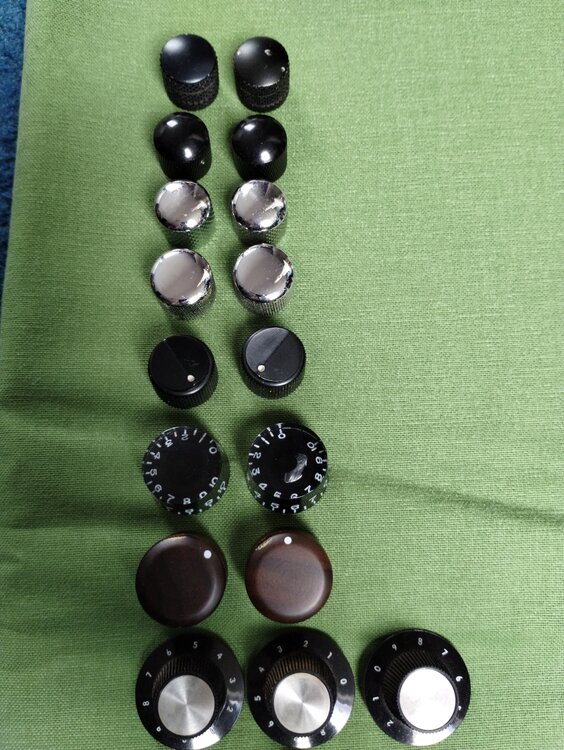
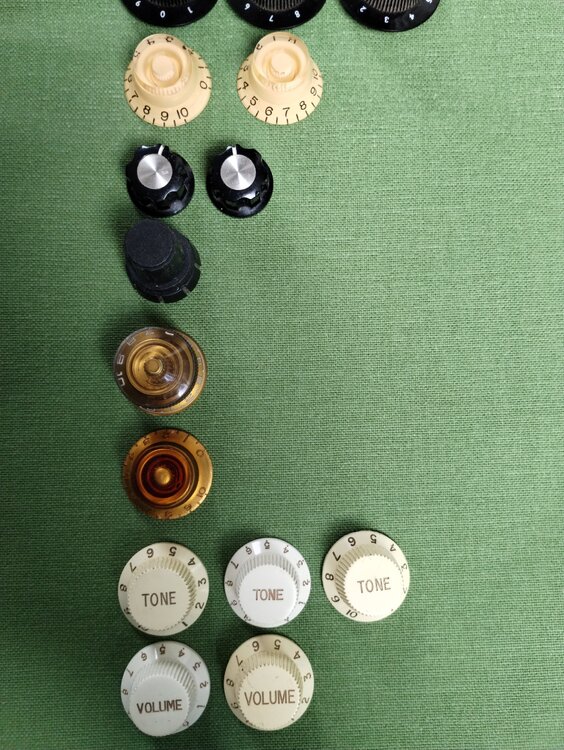
-
Hohner "The Jack" Restoration
Mediocre Polymath replied to Mediocre Polymath's topic in Build Diaries
I'll have to look into Newtone strings, thanks. I'm glad I booked the day off work today, as I'm just sitting around playing it. I have to admit, I'd not expected it to sound this good. It's also even more comfortable to play now that my hands aren't all cramped up from spending a day sanding and working with a soldering iron. -
Hohner "The Jack" Restoration
Mediocre Polymath replied to Mediocre Polymath's topic in Build Diaries
Interesting. I've just been pondering the question of strings, as the ones that came with this bass are properly knackered. I boiled them in some vinegar, so they don't sound totally dead, but they're worn and don't seem to be particularly consistent in terms of string-to-string and note-to-note volume. The front runners from what I've seen of double-ball-end strings so far are Stadium Elites, because they're a) apparently made in the UK, and b) not £50+ like most other sets. -
Hohner "The Jack" Restoration
Mediocre Polymath replied to Mediocre Polymath's topic in Build Diaries
Oh, more importantly, it's finished! I'll take some better pictures tomorrow when I have some daylight, but here's a decent enough shot of the completed bass. I think it looks rather nice, and it sounds good as well. I've attached a quick bit of noodling, recorded direct into my interface with no tinkering. It's neck position, both pickups on, and bridge position. I've since raised the bridge pickup a little, so it should sound a bit less feeble. Untitled.mp3 Thanks to @Chienmortbb for being willing to part with this project bass, @PaulThePlug for his Hohner/Steinberger knowledge and @Jackroadkill for his 3D printing work. Also, special thanks to the cheap white-and-orange beach towel/workbench cover that stars in many of these pictures. My mum bought from a Leclerc in Brittany during a family holiday about 30 years ago, and it's only recently occurred to me that I have no idea how or when it ended up rolled up in a cupboard in my house. -
Hohner "The Jack" Restoration
Mediocre Polymath replied to Mediocre Polymath's topic in Build Diaries
Mostly wiring and electronics stuff today. I started by sawing the old broken tabs off the front pickup and installing the replacement baseplate suplied by @Jackroadkill. As this isn't going to be a visible part, I didn't bother doing any prep or refinement here other than cutting off a corner to accommodate the cable (which was in a slightly different position to where it was on the baseplate) and using a soldering iron to press some threaded inserts into the plastic. With that done, and the 3D printed surrounds sanded and lacquered, I started putting things together. I don't have any pictures of this, because anyone who has ever wired up a guitar will know that the process is extremely annoying and requires intense concentration. I did it without burning myself, and only had to desolder the whole thing, make a cup of tea, and start again once. Which is good going. -
Hohner "The Jack" Restoration
Mediocre Polymath replied to Mediocre Polymath's topic in Build Diaries
Righty, I'm back from a week's holiday on the Devon coast (lovely) and ready to put the finishing touches on this project. In my time away, the lacquer has had time to fully cure. So the first thing to do was the both tedious and nerve-wracking process of wet-dry sanding the bass to get rid of all the brush marks and runs. This is always a fairly scary process, as you just have to keep sanding (constantly checking things) and trust that you applied the finish thickly enough to be able to smooth out all the imperfections before you go all the way through the clearcoat somwhere. If you blow through it, particularly if its in a very visible spot, you essentially have to just throw up your hands, do a lot of swearing and start the whole process again, which can take a week or two to cure. It's maddening, but I've gotten pretty good now. No issues with this job. Here's what the bass looks like now – I've sanded and polished and polished and polished and polished and polished. I then applied the shielding foil to the control cavity and added the ground wire before attaching the bridge (with thurst bearings fitted now, thanks for @PaulThePlug for the recommendation). I boiled the strings and gave it a rough set-up for intonation and action. No electronics yet. One of the great advantages of headless basses (especially double-ball end ones) is that you can string them up and de-string them over and over again without any problems. I've just spent the last half an hour or so playing it unamplified and it seems pretty damn good. No fret buzzes, and it's really surprisingly loud even with just the wood for resonance. One thing that has thrown me a little is just how chunky the neck is – I'd taken measurements and so I knew in theory that it was a big boy, but I was still a little taken aback when I got it in my hands. It feels more like my dad's 70's EB3 than the jazz and stingray style necks on my custom basses. I'm assuming I'll get used to it in time. Even with the chunky frets, the action could probably go lower than its current position (with the saddles decked on the G and D strings decked) with no fret buzz. Not that it isn't playable now, probably low enough for most players, but I'm picky. I think I can file the bridge saddles down a smidge without problems. Tomorrow I'll prep the 3D printed components from @Jackroadkill and put the electronics together. My plan is to put a basic vol-blend-tone circuit in it for now, and then replace it with something esoteric, filter-based and active down the line if I like the general sound and playability. -
That's an interesting thing, good luck. I very nearly bought an SR500 that was in a similar condition and going for about 80 quid, but chickened out at the last minute. I think one of the eras of this bass (I think the mid-to-late 2000s) had a weird matt brown finish that looked like stain, but was actually some sort of extremely thin and fragile lacquer. I think this probably is one of those basses that someone tried to fix. It almost always wore away around where people's hands/picks touched, and as you say, once the protective finish was gone the wood itself wasn't very resilient. The one I was looking at had a 1-cm deep gouge, like a valley leading down to the pickups. Nice basses though, despite all that.
-
Bypassing Pedals or not using them at All
Mediocre Polymath replied to Chienmortbb's topic in Effects
Think this statement doesn't really need any qualifications about effects. Just generally true. -
Hohner "The Jack" Restoration
Mediocre Polymath replied to Mediocre Polymath's topic in Build Diaries
I tried out a whole bunch of options – "Hohner The {my name}", "Hohner The John/Dave/Steve" – but chickened out and went with the original. -
Hohner "The Jack" Restoration
Mediocre Polymath replied to Mediocre Polymath's topic in Build Diaries
That's the long term plan, but for her buying things is apparently a very intensive process, fraught with second guessing and indecision. Possibilities have to researched, options examined, costs scrutinized. I, on the other hand, tend to go "ooh shiny" and get my card out. -
Hohner "The Jack" Restoration
Mediocre Polymath replied to Mediocre Polymath's topic in Build Diaries
So, the measurements of the pickup is the following. Length: 70 mm Width: 38 mm Length to the ends of mounting tabs: 84 mm Width of the mounting tabs: ~13 mm Distance (center to center) of mounting holes ~78.5 mm Does that match up with the dimensions of the thingiverse parts? Incidentally, from playing around with a magnet I think these are reverse-precision bass pickups cast in epoxy soapbars. -
Hohner "The Jack" Restoration
Mediocre Polymath replied to Mediocre Polymath's topic in Build Diaries
Thanks for the very generous offer. Let me quickly measure the actual parts and see how they compare. I'm a floating-thumb player, but the existing pickup surrounds are all manky, scratched and cracked in places. It would be great to replace them if possible (I looked but couldn't find the right kind of low-profile flat-base surrounds). -
Hohner "The Jack" Restoration
Mediocre Polymath replied to Mediocre Polymath's topic in Build Diaries
My wife suggested that, then clapped her hands and said "so I need a 3D printer, you see". She recently changed jobs and is missing her old gigantic workshop with its CNC machines, panel saws and room of 3D printers. I think that would probably be the smart idea, but I'd prefer to get this done in less time than it takes to decide on a model of 3D printer, buy one, make up the STL for the part, print it, etc. -
Hohner "The Jack" Restoration
Mediocre Polymath replied to Mediocre Polymath's topic in Build Diaries
While I'm sitting around, periodically applying more coats to this polyurethane toffee apple, I figure I may as well sort out a few of the remaining issues with the instrument. The big thing to sort out is the damaged front pickup. These basses have a slightly unusual pickup arrangement (for a bass, at least) where the guitar-humbucker-sized soapbars are mounted to pickup rings. The pickups were originally held in place with what my (American-born carpenter) wife identified as No. 2 machine screws. These are anchored into brass threaded inserts that are cast into the tabs on the sides of the pickups. On the back pickup these are still intact and have the appropriate hardware still. On the front pickup the treble side tab has snapped off. I can only assume this happened during the process of fitting the midi pickup system, as I can't see how this fairly sturdy tab could have broken other than if it was dropped onto a hard surface. The previous owner attempted a fix using self-tapping M3 machine screws and a lot of epoxy. They tapped out the surviving bass insert to 3 mm and cut a thread through the oddly rubbery plastic of the makeshift tab they'd glued on. That home-made tab seems to have failed pretty quickly though, and it was broken when it reached me. I have some M2 machine screws and associated threaded inserts to hand, so I'm thinking I'll just cut away both the epoxy tab and the surviving (but retapped) tab and replace them with a single piece of wood or plastic across the bottom of the pickup with M2 threaded inserts. Like so. The pickup rout is flat on the bottom, so I don't need the gap between the tabs. As an interesting aside. The hardware used on this bass is almost all imperial, despite it being a German-designed instrument made in Korea. I'm guessing they were bound by the terms of the Steinberger license to reproduce the hardware exactly, including the No. 2 machine screws for the pickup mountings and the No. 6 woodscrews that are used to mount the bridge and headpiece. -
Hohner "The Jack" Restoration
Mediocre Polymath replied to Mediocre Polymath's topic in Build Diaries
I'm currently brushing on many many coats of water-based polyurethane lacquer. I had two-thirds of a tin of Mann's Extra Tough that I needed to use up, and I don't like using spray cans more than I have to. This also has the advantage of being innocuous enough in terms of smells that I can use it indoors when it rains. Once I've gotten a good thick layer on, I'll sand it down to a smooth finish. It sounds like an odd way of doing things, but it's worked for me on the last seven or eight instruments I've made. -
Hohner "The Jack" Restoration
Mediocre Polymath replied to Mediocre Polymath's topic in Build Diaries
Decal applied. Not perfectly 100% straight, but certainly much closer than the one that was on there originally. -
Hohner "The Jack" Restoration
Mediocre Polymath replied to Mediocre Polymath's topic in Build Diaries
Yeah, I figure I can post them out in the unlikely event that another BC'er is working on a similar project. -
Hohner "The Jack" Restoration
Mediocre Polymath replied to Mediocre Polymath's topic in Build Diaries
Thanks for the tip. I got a full A4 sheet of logos printed, so I have plenty of material to practice with. I just need to find things to stick decals to. The logos are mostly the one I use for my home-built guitars, but I did get four of the Hohner logos printed, plus another four in white (because I wasn't sure how the red would come out). -
Hohner "The Jack" Restoration
Mediocre Polymath replied to Mediocre Polymath's topic in Build Diaries
I've now got to summon the courage to do the waterslide decal on the body. I was always crap at these when I made airfix models as a kid. Used to get my older brother to do them most of the time. That said... I've not tried to apply one since I was about 10 years old, so perhaps I've gotten better at it. I took some pictures and reproduced the original logo in Affinity Designer. I got them printed up as decals (along with the logo I used for my own designs) by a company called Rothko & Frost. I had intended to just exactly reproduce the logo that was on there originally, but – as an editor – I can't countenance such wonky typesetting. I'll also try to put it on straighter than the original decal. I've noticed from looking at pictures of these basses online that the decals are noticeably wonky on about half of them. -
Hohner "The Jack" Restoration
Mediocre Polymath replied to Mediocre Polymath's topic in Build Diaries
Right. The paint has mostly cured now, and I've taken the masking tape off to reveal the final look. I still need to do the clearcoat, but the only thing that will change from this look is the level of shiny-ness. I decided that I was going to lean into the description "poor man's Status" that was often applied to these basses when they were new. It looks a little wonky on the front because the pickup routs are slightly wonky. You can't tell once the pickup surrounds are in place though. If you look closely you can see a thin (like, less than 0.5 mm) line of barbie pink on the edge of the masked off area. I'm not sure whether to keep that visible as a little in joke to myself, or to knock it back with a little bit of red sharpie. -
I use an EHX Bass Soul Food to do just this. For me it's an always-on, very low gain pedal. Just there to put a bit of hair on things. I think there's one currently for sale on the marketplace for not very much.
-
There isn't really a clear "I want to play bass" moment for me. It was an impulse that just bubbled up to the surface from the teenage primordial soup of dumb ideas, anxieties and dreams. When I was 14 or 15, a few of my friends at school started to play the guitar, as did my older brother. I thought they seemed really cool and wanted to join in. My dad would probably let me play his old bass, I knew that, but I was ultimately too chicken to try. At the time, I thought of myself as unteachably inept at any sort of physical skill – I was crap at sports, a risk to myself and others in a workshop and had displayed a spectacular lack of musical ability throughout my childhood. I figured trying to play an instrument again would just be setting myself up for embarrassing failure. At around the same time, oddly, I also developed a sort of nagging and largely irrational anxiety about the prospect of learning to drive. Like, I was aware that this was a thing – a physical skill – I'd need to do, and I was concerned that I would turn out to be just as bad at that as I had been at everything else. I started thinking that perhaps I should try to learn to do something (play an instrument? juggle? knit?) to reassure myself that I was capable of learning something new. The final piece of the puzzle came on a day when I was off school and bored. I was playing 1080 Snowboarding for the N64, and set a time on the "Crystal Lake" run that was genuinely world-beating. Well, perhaps not world-beating, but definitely fast enough that I could write into the magazine if I wanted, get my name in print. I sat there, looking at my character celebrating on the screen, looking out of the window at the sunny summer's day I was avoiding, and had a sudden urge to do something – anything – more productive than this. Something that might make people think I was cool, something that girls might think was cool. I went upstairs and pulled my dad's old bass out of a cupboard. I downloaded the tab for "Dammit" by Blink-182 and started awkwardly plucking the notes. With help from my brother and my dad, I beat my expectations and got surprisingly good surprisingly fast. Haven't stopped playing since. It never did help me get any girls though, and I never did learn to drive.
-
Help with info on Markbass little Mark 250 Blackline.
Mediocre Polymath replied to Chimike's topic in Repairs and Technical
Hi there. Sorry I completely forgot about this. Here's the voltage selector, looks to be on 120/240 for mine. -
Help with info on Markbass little Mark 250 Blackline.
Mediocre Polymath replied to Chimike's topic in Repairs and Technical
I'll have a look in the morning. -
Hohner "The Jack" Restoration
Mediocre Polymath replied to Mediocre Polymath's topic in Build Diaries
Happy update. Got a can of Kobra "Venom Red" from the local DIY store and this is the colour I was hoping for (going for an Audi Quattro sort of a colour scheme).


