All Activity
- Past hour
-

If you were starting today, what’s the best way to learn?
Geek99 replied to Useless Eustace's topic in General Discussion
You never finish being a bass player so you’re good to go there 👍 -
It's interesting to compare how 'easy' (I use the term loosely) it is to get started o various instruments... Certain types of instrument are inherently more difficult to make progress on. There's a reason why the recorder is used as a beginner instrument as it's easy to blow and the fingering is simple. The only down side is that for the small hands of children it means using the descant recorder, which is very high pitched. The treble recorder is much nicer to listen to. Here's a consort of recorders from treble to the sub-contrabass... Main challenge with 'standard' recorders is that you need to learn two sets of fingerings for F and C instruments, as unlike say saxes, they don't transpose so you have to use different fingering on the different pitches (i.e. descant and tenor are same fingering, treble and bass are same fingering). Single reed woodwind instruments are relatively easy to get going on. This is the clarinet and saxophone families. Saxes are easier than clarinets. The embouchure is not too difficult and fingering over the core two octaves is mostly straightforward. Clarinets are trickier. I play saxophone and in my first lesson, I was getting basic notes out of it back in 2011. The core couple of octaves of D below treble staff to the D two octaves above are relatively easy to learn. It takes longer to be able to do the lowest notes (down to Bb) and the highest standard notes up to top F#. Double reed instruments are MUCH harder to get on with. The main ones being the oboe and bassoon families. not only are these instruments difficult to play/learn they are also inherently much more expensive. String instruments of the violin family are relatively easy to get basic sounds out of but present challenges of coordinating fingering with left hand and bowing with right. Cello is easier as you don't have to seal with holding the instrument up like violin or viola. Getting to a reasonable standard is more challenging. And that brings us to brass.... I have only recently tried to play a brass instrument and it presents a lot of challenges. You have to maintain an embouchure, similar to sax, but you have to 'buzz' your lips as well. For a given combination of valves, there is a harmonic series of notes that will come out. You have to adjust your oral cavity - mostly by raising/lowering the tongue - to be able to get different notes from teh harmonic series. For example, the base open note with no valves is a 'C', the next harmonic is the 5th at G, then the octave at the C above, and so on. to play a specific note, you have to think about 'pitching' it since even at my basic level, 'open' (no valves) can produce one of 3 notes depending on how I pitch it. The number of choices will increase as I improve. Using valve 2 will give me the B below middle C, F#, then the B an octave up. I've been playing since the end of last September, initially with weekly group less with the band, I now have a weekly private lesson. I can just about play from B below middle C to the C an octave above, so a 9th. Apparently, that's about what you expect for someone that's been learning for a year. Admittedly I have some advantages in that I already read music so do not have to add that into the mix.
-
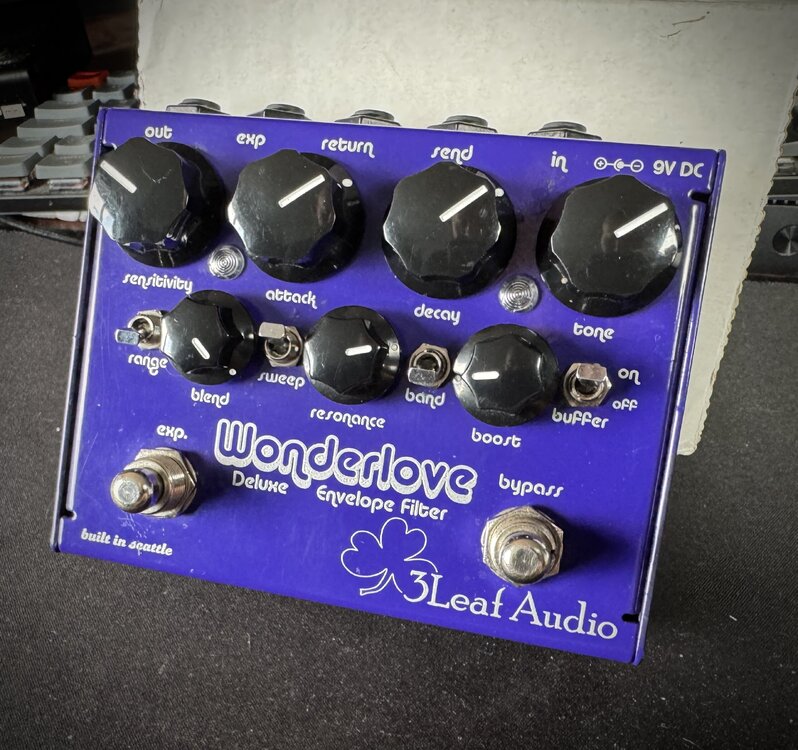 3 Leaf Wonderlove... having not found a new owner for my Proton, I've decided to put it into use but can't have two 3leaf filters sitting around. This one I prefer considerably, but it's not quite as pedalboard friendly. Knowing my luck with selling 3leaf stuff the asking price for these will be a grand within days of me letting it go (see original proton, octabvre Mk3 🤦♂️) This is the deepest, wahiest filter pedal I've ever had and the routing options are very useful. Boxed, Price includes speedy, tracked UK postage.
 -
Most likely @Mrbigstuff got it right with a 4 bolt neck refinished. worth checking the underside of the neck to see if there was ever a 3 bolt fixing (I’m guessing not!)
-
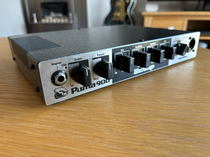 Excellent amps 👍
 -
I agree - lots of inconsistencies and to be honest I can't really say how accurate the description of it was, but to be fair it was fully disclosed as a parts bass and I bought it for the sound rather than any idea of value/collectability.. The only things dating the body to 1972 would be the neckplate (1972) and the pots (1970). Early '70s bodies do tend to be a lot lighter than late '70s, especially as most of them were still alder at this point, but ash bodied basses around 5kg were a thing even back then. There's also the possibility that it's a maple body - Fender did experiment with maple that was even heavier with ash in the early 70s - Steve Harris' original P bass is an example of this. There's not much bare wood visible so it's hard to tell, but the neck pocket is fairly intact and unpainted with no sign of it ever having been a three bolt, so I don't think it can be earlier than 1974/75. I'm also pretty sure it's not an aftermarket body. The pickup routing and neck pocket show the usual (poor) quality of CBS Fender, and the '70s pickup spacing is hard enough to find on aftermarket bodies even now.
-
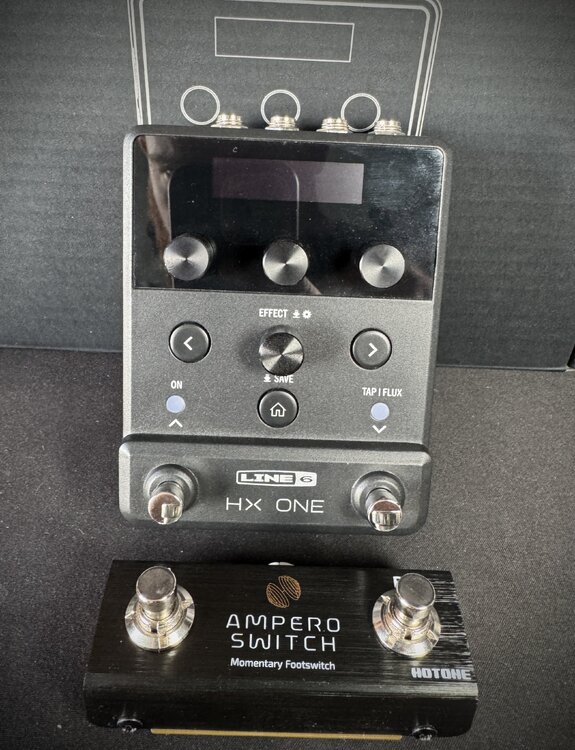 Line 6 HX One with Ampero Switch (and cable, unpictured). Line 6's 'one at a time' access to everything in the Helix FX department. Boxed with power supply. Great condition and rarely used outside of the house, Price includes tracked and speedy UK postage. .
 -
I can’t quite work out what’s happening with the neck, a S7 should have a bullet truss rod and 3 bolt neckplate , but the stamp reads 1977 4-Thursday, and to me the logo looks genuine , strange
-

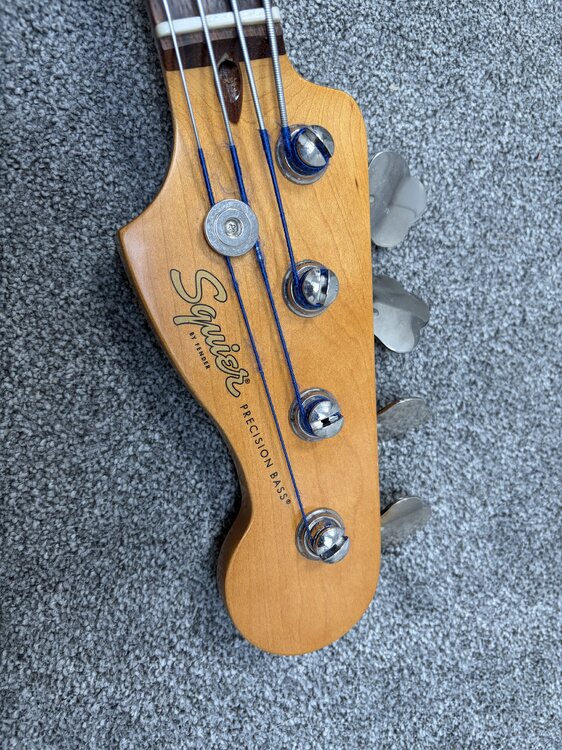 Here is a Swuier Classic Vive Precision neck with factory fitted tuners and a neck plate and screws. Its in great condition with minimal play wear and no damage. Looking for £125
 -

Storing a neck that is not attached to the bass
Jean-Luc Pickguard replied to Jeffskowski's topic in Repairs and Technical
The truss rod exists to provide force acting against the force applied by the pull of the strings. As there would be no string tension, I would slacken the truss rod off to prevent it forming a permanent back bow, wrap it in bubble wrap and store it a room temperature — ie not in the loft or shed. When I bought a Fender replacement P to J conversion neck, it came with the truss tod slackened off, so I slackened off the rod on the fretless it was replacing before packing that one away. -
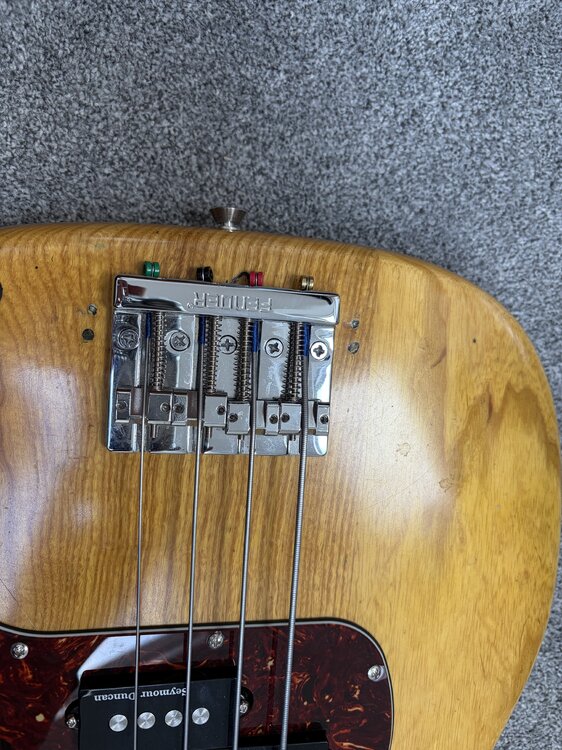 Here is a 1970s Precision body which comes fully loaded. I do not know whether this is a Fender and it is being sold as not a Fender. (It has lots of the route marks to be a Fender but I can’t guarantee it is hence the low price.) The body was black but is now naturally finished. There is some minor routing inside. It comes fitted with: Fender Hi-Mass bridge Kiogon loom Brand new Seymour Duncan QPs its a heavy body. With the neck it’s around 5kg. Looking for £250.
 -

If you were starting today, what’s the best way to learn?
SteveXFR replied to Useless Eustace's topic in General Discussion
You'll be needing to learn to play with pick and fingers. -
There’s no way the neck ever had a bullet truss did in it. That’s a factory made neck.
-

Sir Horace Panters “Ghost Town” Precision Auction
TimR replied to Lozz196's topic in General Discussion
It's the same with Elvis and Beatles memorabilia. It's only valuable to those who have memorability. -
Sir Horace Panters “Ghost Town” Precision Auction
TimR replied to Lozz196's topic in General Discussion
Which was my point about being valuable to Gen Xers for maybe the next 10 years and then lose value. -
I agree. The better preamps are not as important in live settings, for the most part (in my opinion), while the additional functionality of the X32 rack over the XR18 seems like a more useful thing to have.
-

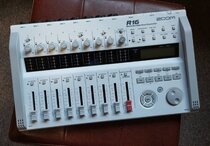 It's a multitrack recorder, using SD cards as storage. 16 tracks total, can record 8 inputs at once, and supports an unlimited number of virtual tracks / alternative takes (well, limited by the space in the card!). Built-in stereo microphones. Wide range of on-board FX. Power supply included, but it can also run on AA batteries. It can also work as an interface to control a DAW on the computer. https://www.zoom.co.jp/node/68/1000
-
- 3
-

-
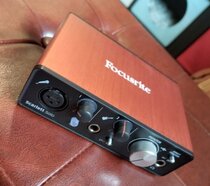 2nd Gen Focusrite Solo USB interface, 2-in/2-out. Can be powered directly via USB. Great condition, light home use only.
 -
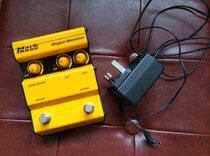 Independently footswitchable clean boost + VLE ('vintage loudspeaker emulation' low pass filter) and VPF ('variable pre-shape filter', a bit like a 'contour' control, scooping mids while boosting low/highs). Standard TS output plus balanced DI output (XLR). Original MarkBass power supply included (but it works fine on standard 9V supplies - I used it for years with a T-Rex Junior supply, you just get a bit more headroom if powered with 12V) Bypass can be buffered or true-bypass (switch at the bottom). It can work very well as a way to split the signal into FOH and an independent IEM rig or backline.
-
- 2
-
-
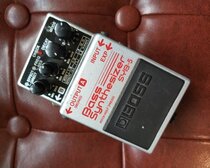 Classic bass synth pedal. It's seen a lot of action and has a few scuffs to show it, but it's only cosmetic. https://www.boss.info/us/products/syb-5/
 -
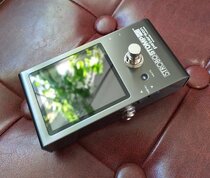 Great tuner with lots of options and a brilliant display (with assignable pretty colours too ). Home use only, great condition. https://www.petersontuners.com/products/stroboStompHD/
-
- 2
-
-
I'm not as sophisticated as that I struggled for years to sing at all until I discovered that I could sing in tune when we had decent monitors. I can still only sing what I can hear and that almost always means the melody line only. Most of the singing I do is with my duo. Our 'act' is based upon getting the audience to sing along and I sing what we want them to sing essentially. I just provide a fuller sound in the bits we want them to join in with. It seems to work, much to my surprise.
-
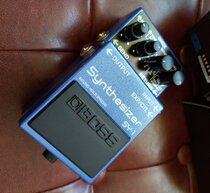 Great condition, light home use only. Very good tracking. https://www.boss.info/us/products/sy-1/
 -
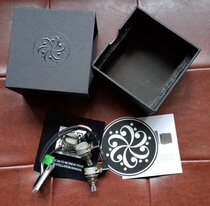 I bought this a while ago but then I changed my mind and it was too late to return it See all details about the preamp here: https://www.darkglass.com/en-gb/pages/tone-capsule-manual and here: https://www.darkglass.com/en-gb/products/tone-capsule Basically, it's a 3-band with lows at 70Hz, low mids at 500Hz and high mids at 2.8KHz with very easy wiring assembly.
-
- 4
-