


itu
-
Posts
4,375 -
Joined
-
Last visited
Content Type
Profiles
Forums
Events
Shop
Articles
Everything posted by itu
-
You can glue nearly anything to a graphite if the epoxy/glue is right. MG has used Chakte kok, our dear @Kiwi uses PEEK, phenolic resin is fine etc.
-
I agree with the notes written by @Hellzero. Try several basses. When you find a nice feeling one, start the hunt of the best strings. Visit a local luthier for a pro setup. Most of the pickups are like SD, EMG, bartolini, and all sound like they sound. But the setup and choice of strings make the best out of the instrument. We do can discuss endlessly about brands, pickups, scale lengths, etc. "No matter what others try to say, my choice is always the best and the only one." Someone said that the amp and cab should go to 30 Hz, and that's nonsense. A good cab that can produce 30 Hz within 3 - 6 dB of 60 Hz is huge and heavy. A good cab is able to go down to 60 - 80 Hz area (first harmonic), because ear creates the lowest end. Usually all frequencies below 50 Hz are more or less eating your headroom out: cannot be heard, but need lots of power. Handling noises and very lows are better to be tamed by an HPF. Try one and set it by listening. You'll be amazed of the frequency after you have set it right. Cannot be heard, but does a lot.
-
Start with pickup adjustment or simply turn more gain from the amp. Make a trial with different strings to find the set you like the most with this bass. tapewound - flatwound - groundwound - nickel RW - SS RW ...and of course try different gauges.
-
They were available from Modulus Graphite and Vigier, among others during late 80's and 90's. MG started to put truss rods back after some people did not like the neck without a rod. I do not see it a must, but as some say, your mileage may vary.
-
I'll take the one that's left after others have...
-
First of all, understand the flow of blood from fingers (and toes) to heart. Arteries are hidden under muscles, therefore you have to worry about veins that are close to the skin. Veins - especially in legs - have valves. Those valves are important and shouldn't be ruined by massaging from heart to fingers or heart to toes. Got it? Once more, which way? Always towards the heart! My suggestion is to massage finger muscles that can be found from forearm, close to the elbow. If you have a muscle hammer (even a cheap one is just fine), that is one nice tool (at lowest setting). Did I say something about the direction? Make it easy, start softly, just like any sports. Warm muscle can be hit harder, but I still suggest long, soft massaging several times a week to remove the lactic acid. Drink a lot of water, it helps a bit with this. If the hand isn't any better in a week, meet a specialist. Playing is sports of one kind. Keep your hands and hand muscles warm.
-
I'd still choose a used one. The selection is wider, and the bass is stabilized over the time. A new one may be hit-and-miss.
-
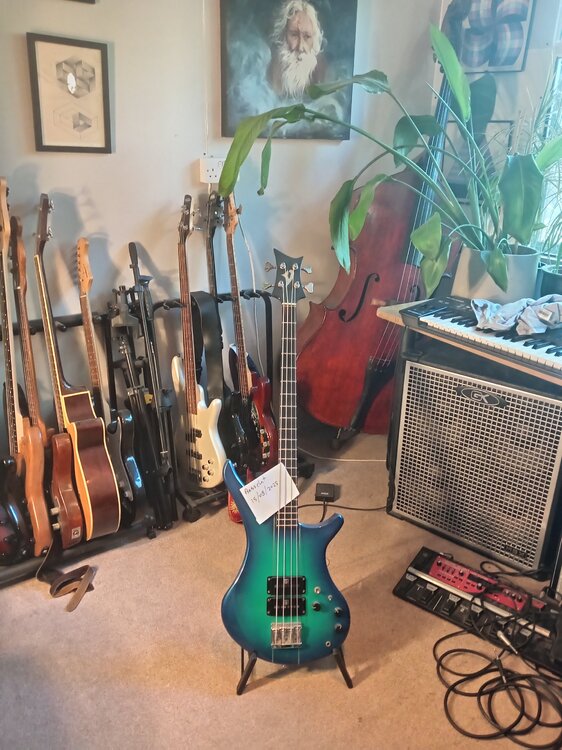 These pickups have visible polepieces: older model.
 -
Thanks for the tip. Michael sent a note that I'm on the wait list.
-
What are your irrational prejudices? I have some bonkers ones...
itu replied to kwmlondon's topic in General Discussion
Exactly! Off from this thread, I recommend you the film Tous les matins du monde. P. S. Sir, sorry about the verb "hate", but somehow it fits this thread of exaggeration, and strong personal opinions. -
What are your irrational prejudices? I have some bonkers ones...
itu replied to kwmlondon's topic in General Discussion
I do hate people not knowing history. Double bass belongs to gamba family. Burn those violins. And stop using that g-word. It's an electric bass. -
Just a few corrections. Semiparametric eq - 3 way selector 0, ±15 dB (mini toggle) - frequency selector 80 - 5200 Hz (pot) Neck: Carbon fiber with a modern C profile. Pickups: Benedetti single-coil. Electronics: (where did this come from?) Scale Length: 860 mm
-
If changing the setup to BEAD requires a bass change, go for it. By the way, how do you manage string changes with your other basses?
-
An easy trial is to put fuzz/flanger/chorus to the bridge pickup and keep the neck pickup as is. If you have two amps, fx sound could go to the weaker one as it will be heard over those clean basses. X-over acts pretty much the same.
- 1 reply
-
- 1
-

-
Singer: PA sounds strange. Me: Cables? S: Yes, connected to PA and speaker. Me: Is the power ON? S: some words that cannot be used here.
-
@Owen: The fretboard of the Tribass has "switches". The three "string" thing is doable, although fourth would make fingerings even easier. What, no E, A, and D? As you would need extra "frets" to get sounds from the free strings, they are hidden to your right hand. Right hand can do a couple of things with the touch screen. There are E, A, and D, as well as few different ways of playing those three strings. I suppose that the screen is the most energy consuming component of the unit: lights usually take their part. Pros: very light weight, a handy tool, MIDI out, no latency, rechargeable. I'd say the unit is made well, the feel is very good. Cons: only three strings, E, A, and D on the right hand side, it takes some time to get used to the UI, and of course the availability of the unit.
-
Aren't US prices VAT excluded? Local taxes + VAT = a lot more.
-
The important word here is the service. We customers are buying a service which includes decent manners, and even a product. It's true like @SumOne said that it's legally a must, but not all companies are the same when buying, needing support, or returning items. @Phil Starr's experience is a great example how I would love to be treated.
-
How to troubleshoot a battery drain (Spector NS5CR)
itu replied to Rigetto's topic in Repairs and Technical
Short in the circuit. When the bass is unplugged, no current should be visible.- 7 replies
-
- 1
-
-
- spector
- spector ns5cr
- (and 5 more)
-
In 2004 I went to listen to G3 tour (Fripp, Satriani, Vai) with three friends of mine. The venue was made of concrete and the volume was infernal. All I heard from Billy Sheehan was bzzzzzz. No chance to hear any notes. We left after fourth "song". A g-word player friend of mine was working there and said the same, the sound was a chore. I couldn't have believed that good players were counting on volume instead of skills - and Vai's hair fan was just ridiculous. Yngvie may think it differently, but there exists a level of too much.
-
18 and 19 mm are doable for me but not 17 mm. Most 5-string basses are 17 and therefore a no go. That Roscoe looks super!
-
Headphones, at least Nux and Valeton has one. Two buttons Ditto was not as useful as I thought, but I am an old fart, and for me it's hard to learn even old stuff.
-
...and I was referring to an old cartoon.
-
"Me stupid? Sorry, I don't understand."
-
Isn't it candle wax?


