


knirirr
-
Posts
647 -
Joined
-
Last visited
Recent Profile Visitors
14,102 profile views


knirirr's Achievements



-
 I have exactly the same, for the same reason, but using little black dots of the sort usually used to cover cameras on laptops. These can only be seen close up.
 -
How was Your rehearsal last morning or night ?
knirirr replied to nilorius's topic in General Discussion
Last night's rehearsal was difficult, trying to get the finale of Anything Goes to work. It doesn't help that I'm on guitar for this show, but the incentive to practice is useful. -
200W is plenty for me (with a 1x12 cab), but I'm playing jazz and if guitarists are present they're going to be playing clean and at a sensible volume.
-
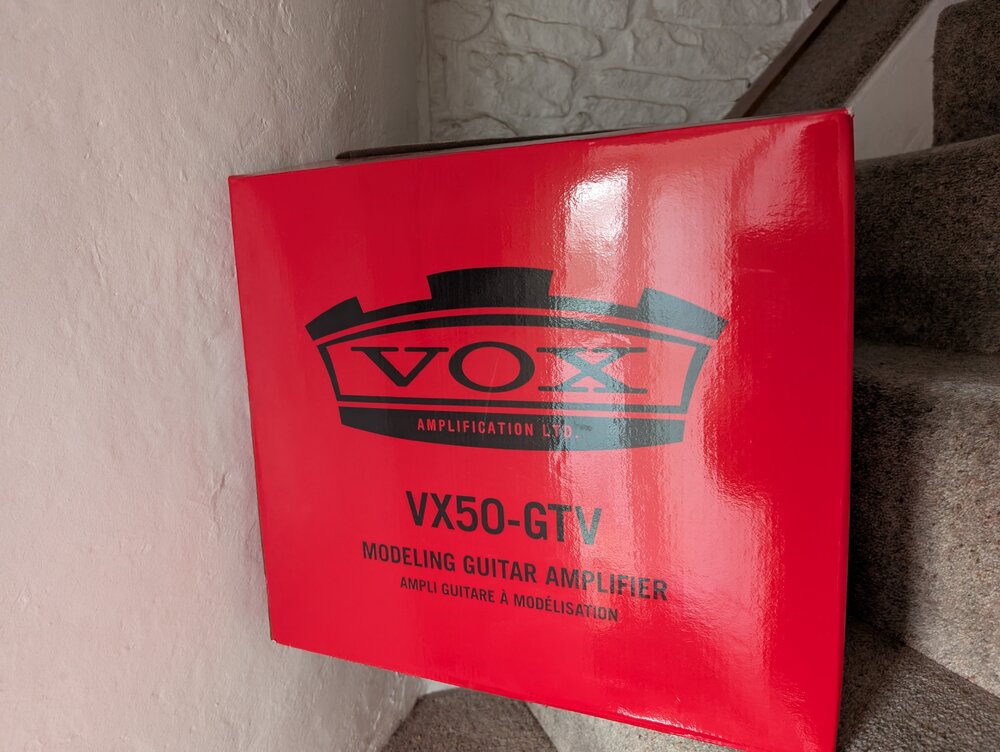 A review of this amp can be seen here, and Vox's product page is worth a look. As the reviewer mentions, this amp is both small and light (< 5kg) and also loud; I've used it for several jams and also a gig (all with a drummer and various saxes etc.) and it has been fine. I never much liked the tone (a bit too rock) or used the effects, so I've replaced it with the recently-discontinued jazz version whilst I still can. I've not included postage in the price as I don't know how much it will be, but in the event of anyone being interested we can discuss options. The box is still present and I'll put in the unused new power supply from the replacement amp (it's identical). There are a couple of small marks on the bottom of the grill surround (pictured) but otherwise it's in good condition and all working.
 -
We played The Shed in Charlbury tonight; it's a small venue but popular with the jazz crowd. This was a fundraising gig to cover some of the costs of the recent refurbishment there (nice to have working electricity which is up to safety standards...). It was a good turnout considering we'd never played there before and the locals wouldn't have known what they were going to get. Luckily, they seemed to have liked it. Edit: Video available.
-
This is something which occurred to me recently and which may well not be novel or clever, but I found it useful to think about. At jazz jams we try to run them so that the material played is fairly standard, as we'd like to encourage new players to get up and have a go. Nevertheless, anything could be played if someone brings a chart for the rhythm section and, if necessary, lead sheets for horns. Despite this we do get people who do some or all of: - Don't have charts or the ones they have aren't much use (see below). - Can't explain the form or changes to the rhythm section, sometimes saying "just listen"(*) or "just watch my left hand and work the chords out" etc. etc. - Drop or add bars/beats as they please. - Change tempo unexpectedly. It's tempting to think that they are simply bad musicians, but they sound good when playing their own material and are able to get gigs which I am sure their audiences enjoy. So, I think it must be some sort of cultural difference, specifically that I'm thinking of things bottom-up and they're thinking top-down. For the bottom up view there's a set form and a set sequence of chord changes which the rhythm section will lay down. The singers, horn players etc. can add their stuff on top but they must follow that underlying structure. They could perhaps push or pull slightly against the beat, or substitute some chords, but the form must be respected. For top-down the lyrics and melody are the defining part and any accompaniment then follows whatever the singer (or perhaps instrumentalist) is doing - strumming an acoustic guitar to underpin one's own signing would be a good example. The sort of charts which consist of the lyrics of a song with some simple triads and occasional dominant chord written alongside are not much use to me, as the form is not clear in them, but I think they'd make total sense if thought of from a lyrics/melody-first perspective (presumably why acoustic-guitar-strummers use them heavily). Does this seem at all reasonable? If I'm not barking up the wrong tree, suggestions on how it might be easier to work with the top-down people when they turn up are welcome. (*) Of course, at some jazz jams one might be expected to "just listen" without charts but then I'd expect the tune to be a known structure and get some clue like "It's in Bb, AABA form; A sections are 12-bar Bird blues and B sections are a rhythm changes bridge" shortly before the count-in.
-
Do you mind if I ask what you didn't like about it? As it happens I did a grade exam around the same time, also with a merit, and didn't much fancy another one. There was no time to warm up and at one point I was surprised by a request to sing from dots, which is never going to happen.
-
How was your open mic or jam night last night?
knirirr replied to tauzero's topic in General Discussion
Some of them, particularly singers, turn up with something they particularly want to do (often the same each time), but there are plenty of instrumentalists who are happy to play on anything. Changing people over is a faff (the space is quite cramped) so when singers come up they are often allowed to do a couple of tunes; horn players will be invited to come up for these. This jam is one of the reasons I took up playing guitar again. We started getting some bass guitarists looking for jazz practice, so I thought I could do a little guitar whilst they were up. Then, once I'd got into it, jazz guitarists started turning up as well (N.B. the guitarist mentioned above is not a proper jazz guitarist, as their answer might suggest ;-). BTW, in addition to our jazz jam there are two folk/acoustic sessions and one open mic night in the town per month as well. -
How was your open mic or jam night last night?
knirirr replied to tauzero's topic in General Discussion
Interesting idea - I'll have a think on how we could manage that. We have a sign-up sheet, of course, but that's not particularly clear to the people waiting. -
How was your open mic or jam night last night?
knirirr replied to tauzero's topic in General Discussion
Last night at the Chequers in Chipping Norton was rather busy. So were the two sessions before that. We're attracting a variety of players and also audience and it's getting to the point where it's hard to fit everyone and we're over-running or missing people out, or both. Not sure how to fix that. There was some good stuff played, though. Strangely, no drummers turn up; our chap has to play all night, but we usually get at least one other bassist and we had three guitarists last night. This is a jazz jam with a website which reminds people to bring charts for the band if they want to call something not in iReal, real books etc. But: Guitarist: <calls unfamiliar tune> Bassist: How does that go? G: It's in G. B: What sort of progression? G: It's a blues. B: Is it a standard 12-bar? G: No. B: What is it, then? G: It goes something like G G G G G G G D, I think. B: Do you have a chart? G: No. etc. etc. -
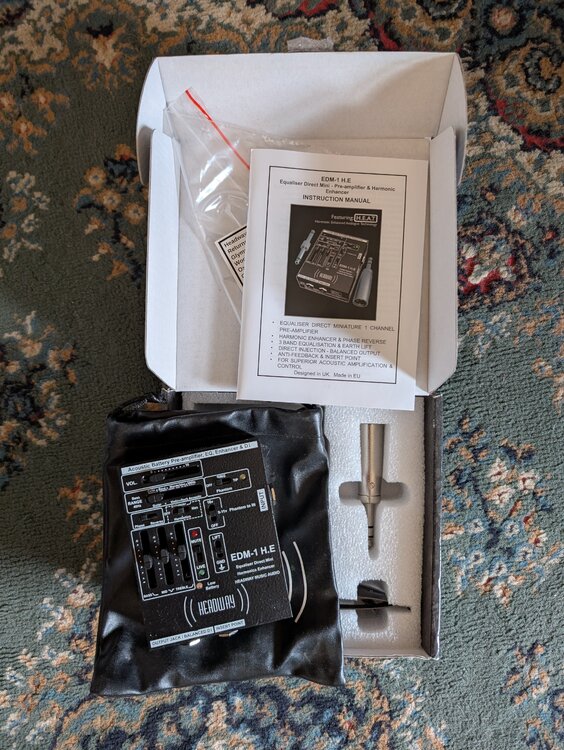 As shown in the picture; original box and accessories included. I didn't use it much as I changed DB pickup and found this was no longer needed. There would have to be postage as well, depending on what the buyer would prefer, or collection.
 -
This afternoon I felt like listening to the '92 Seville blues night again. It was great when I heard the original broadcast; I'd not heard of some of these players before.
-
It's not that bad if you've got a free corner of a room in which to lean it. The main difficulty is getting it down the stairs...
-
The two are complimentary. Honest.
-
Some things it would be nice to do in 2026: 1. Improve my DB soloing. 2. Improve DB speed and endurance for when horn players call rhythm changes at high tempos etc. 3. Do more jazz gigs on DB, ideally with multiple horns. 4. Get together a jazz group with me on guitar.


