


Jack
-
Posts
2,613 -
Joined
-
Last visited
Content Type
Profiles
Forums
Events
Shop
Articles
Everything posted by Jack
-
For what it's worth it is technically possible. I have a usb c dock that I normally carry in my laptop bag that works with my tablet. Tablet is a Samsung something or other, router is a mikrotik and the dock is a little ugreen one from Amazon. Oh well, hope you get it sorted!
-
When you tried at home did you turn the wifi on your phone off? Exactly the kind of thing that I would do would be to plug in a (useless and non working) cable, connect to the internet over wifi and tell myself that the cable works.
-
Hi all, I'm buying my old Junior Jet back after a 6-year loan to a fellow local bass player. What strings are you all using on yours? As I recall they are difficult to find and you often end up with a mix of actual string and silk around the tuning pegs which isn't ideal. I understand that short scales Chromes (ECB81S) fit really well, but I can't stand Chromes! I would probably prefer flats over rounds but I will gladly put well-fitting rounds on over badly-fitting flats. Average tension preferred, leaning towards higher if I have to pick a side. Thanks in advance.
-
It bothers me that some of the cables don't go all the way to the edge of the frame!
-
So you want to use them in the place of centre fills but not necessarily as centre fills? Not ideal but then we've all worked with less than ideal setups before, just a part of gigging in the real world. Normally when one puts speakers there they are used to make sure that people in the very front of the audience can hear the things on stage that don't produce much volume on their own. The thinking being that if you're right at the front then the main pa is shooting over and past your ears. So it's often vocals, vocals and more vocals in centre fills as things like drums and guitars are probably making enough stage volume on their own for the first few rows. If possible I'd put the extra speakers on an aux send, that way you can do their own mix and eq. Even if they are just duplicating the main mix and being used as extra volume rather than extra coverage they're still going to sound different and the added control of being on an aux send will likely help.
-
Sorry for all the quotes, just getting caught up on one of my favorite threads. Downsizing from multiple pedals to a multi is definitely a 'thing'. Much easier now as well as they are all fantastic, you could honestly gig with nearly all of them. Although I'm sure in 10 years time they will all sound terrible again! I still have a little analogue board with 3 pedals on a nano, but my QC (and before that my HX stomp) is just my rig now. What else could you need? He says, looking at the limited edition Sansamp paradriver... Pleased to see I'm not the only one, although it still feels like cheating. Just for three songs in our set, what about you? That is slick. Have you seen the little cable ones? They put a bit less strain on the jack socket IMO.
-

Mismatched top, would this bother you? Cort space 4
Jack replied to 41Hz's topic in General Discussion
That would bother me. -
I once spent £250 on a pickguard and it wasn't quite that nice. Of course it came with a free bass
-
In fairness that is beautiful.
-
Oh trust me, if I was being funny you'd know about it as I am hilarious. My point was that if you're sitting at home doing late night practice or whatever using IEMs then fine, do whatever sounds best to you. But if you were playing live and using IEMs then you might go to great lengths to get it to sound great to you in your IEMs, and in doing so ruin the sound that the audience hear through your amp or the pa or whatever.
-
Is this for playing live? If so, the audience aren't wearing iems.
-
I might have a situation where I have to use a traditional backline for a bit. Can the QC run enough output to properly drive a PA power amp? 1.4V?
-
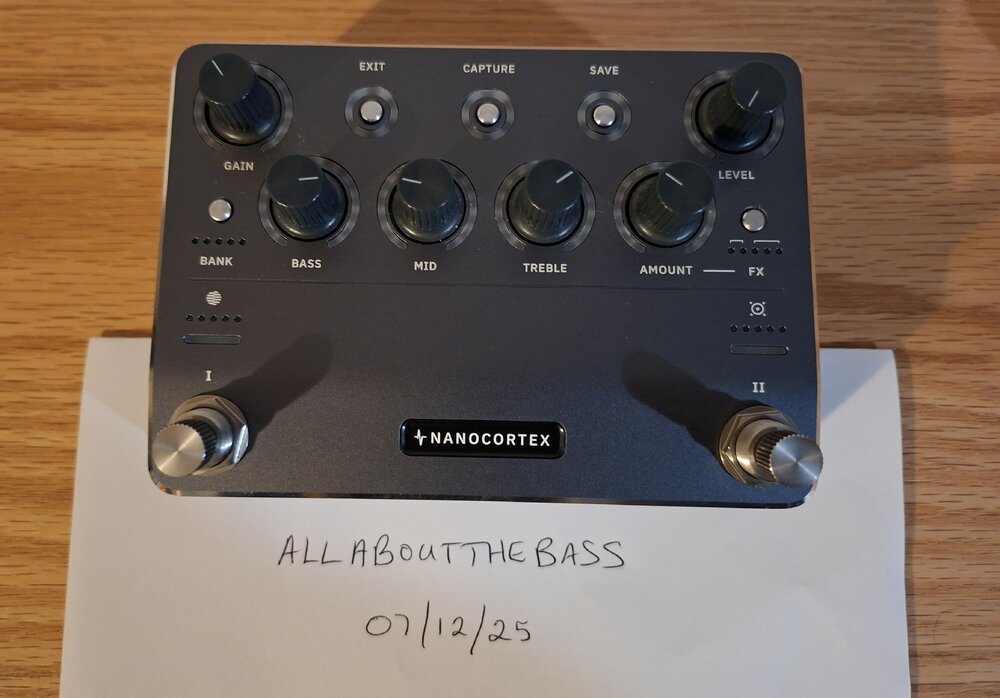 These have always been brilliant but they've just had a massive update as well.
 -
There's no need for a talkback mic for the soundguy, I'll just lean over on stage and talk to him. That sounds nice, thanks Matt I'll float that with him. As for the Studiospare I know what you mean, I'm not selling mine either.
-
I figured but then I also know that what works in a rehearsal studio doesn't necessarily work at a gig. Good to know that in this case though it pretty much does, weight off our mind. Oh he's buying but it's been stressed that he's on a budget. Not my business past that. Thanks for the other suggestion, that's the one I mentioned in the op and I'm with you, I think it's the budget contender at the moment.
-
Thanks for the help all. That's at least two votes for the passive di, two votes for the Behringer ADI, no votes at all for any kind of amp, several mentions of soundhole covers and even a recommendation for a piece of gear I already own and specifically ruled out in the OP. Seriously, there is a consensus and I really appreciate it. I think the direction is to stick with a passive di for now and see if a cheap preamp comes up or maybe have him buy the Behringer further down the line. Oh well. I am surprised the inbuilt preamps and tuners are actually useful on gigging stages, but hey, that's why I asked! Possible side quest for a sound hole cover but I know he is not interested in buying gear and I'll bet this is one those "don't need it until you do" things that people won't be convinced on until it's too late.
-
Using my extensive knowledge of vintage instruments I can tell you that the neck plate was made in Japan sometime before 2025.
-
Hi all, Unusual request, just looking for some advice please. I've joined a jam band with an old friend and we're at the point where we're going to start shopping for gigs. Out of the 5 of us, 2 of us (me being one of them) have played in plenty of gigging bands before and we have hundreds if not thousands under our belts between us. The drummer and the singer haven't gigged before but they are sorted. The issue is with the acoustic guitarist. He's a nice fella and a great player but never left the bedroom. Currently they own a nice selection of acoustic guitars and that's it. No stage gear to speak of. I even had to show him how to plug into the amp at the rehearsal space, no joke he had the instrument cable from the guitar in the speaker output of the head. Have any of you ever played acoustic guitar in a band or been in band with someone who has? Advice for what gear you need to be able to actually do that? I would lend him my Fishman Platinum Pro, but once I've done that once I'll be doing it at every gig and I don't want to start a precedent. We have a full pa setup so he could go ampless and then rely on the wedges I suppose. I get the impression that most acoustic guitar amps are relatively flat anyway? Or do nice-but-mid-range acoustics benefit from some tone sweetening? So is it just a plain DI box then to get the guitar into the mixer? I think that all of his guitars have built in preamps and tuners, so just a passive DI would work. But then wouldn't it be nice to have some eq and feedback fighting options on the floor? Or a better tuner? Do the inbuilt ones on guitars work on loud stages under bright lights? What's a good budget acoustic guitar amp? Or preamp pedal? I have seen the Sonicake ones that look alright but they don't have a tuner. Do multi effect pedals work well with acoustics? It occurs to me that something like a Mooer/NUX/Valeton 'hx-stomp-alike' might be a good solution to this? I don't even know how to ask an intelligent question on this as you might have guessed. I own an electro acoustic and if I had to play it live I'd just plug into the quad cortex or the aforementioned Fishman, but that's because I already own those solutions and I'm not an acoustic guitarist by trade. I'm trying to remember back to when I've shared a bill with acoustic guitarists or when we've worked weddings and I've had them through my desk and pa as the first acts. I think most of them have had some sort of pedalboard, mostly with looper pedals, but I guess that's not appropriate for a band. I guess what I'm asking is: for a player who has been playing for a long time but who is brand new to playing live (and who is on a tight budget) should we go amp or pedal board? If so what are some good cheap options in those categories? Is there anything else here that I haven't thought of? Thanks in advance.
-
Jealous. It's all TC Electronic around here. Sounds great and all, just isn't very exciting.
-
Mine came with the top set, but I was sent the bottom set. Long gone now I'm afraid!
-
I too have the software but none of the presets, a little frustrating as I can remember being sent the 'new' ones from Alex.
-
Iirc the plate amp was an off the shelf part (with custom dsp curves) that was discontinued. That was the main reason those cabs were stopped, although Alex did say he had a stock of parts on hand. My point is that the amps exist outside of Barefaced and having it fixed may be easier than you think. Have you checked the fuse?
-
What are your irrational prejudices? I have some bonkers ones...
Jack replied to kwmlondon's topic in General Discussion
This is the only thing that YouTube gets right. You have to disclose if you're being paid to shill something. Other social media sites either have looser policies or don't enforce the ones they do have. Both my wife (who's into witchy stuff) and her sister (who's a piercer) have been approached multiple times for sponsored posts by companies and said no every time. We do have a friend (a female warhammer player) who started saying yes to offers. Oh to be a gorgeous goth woman like those three. Meanwhile I'd happily lie about anything for 50p but as an ugly bloke my options for 'collabs' (shudder) are somewhat more limited. I'm joking, as business owners they work really hard and are at the top of their games, they deserve all the success they are getting. God knows we're not retiring on my salary. -
I really wouldn't worry too much about the topology. Apparently early switch mode ones could introduce some noise, maybe some super cheap ones still do, but I also think I read that's been tackled in the pedals themselves with them being designed to filter out the squeal. Obviously if you raid the depths of Aliexpress or Amazon then you will be able to find some absolute garbage but there's no major reputable brand that will sell you a bad power supply these days. Unfortunately, there's plenty that are unsuitable for other reasons. Having said that I looked on stinkfoot and apparently the Zoom only draws something like 150mA, so that's way easier to power than I expected and you should have a few more options open to you. Like for instance... ... they look great.
-
You can see how much space you need on Pedal Playground so have a play on there, add the pedals you need and see what takes your fancy for a layout. When it comes to power, you really do get what you pay for and unfortunately they are expensive things. The critical thing for you are the Zoom (and possibly the Ditto) pedals. With digital pedals you really want them on an isolated output and so it would be best to have at least one output that's isolated from the rest for the Zoom. I don't have any experience with the ditto units, someone else may be able to advise you if they also need to be isolated, both from the rest of the pedals and also from the Zoom. The rest should be able to share. Do be careful with power supplies. The voltage and polarity of the power supply's output and the pedal's input needs to match EXACTLY. The amperage of the supply needs to meet or ideally exceed the draw of the pedals. There are websites that can tell you what your pedals need in terms of power if you don't already have them. Just google something like 'tc ditto power draw'. The Lekato that you link to looks as though it doesn't provide enough power for at least the Zoom (which I bet needs more than 200mA). It is possible to buy adaptor cables to do pretty much whatever you want though, so you could 'add up' several of the 200mA outputs on that board to get the required power for the Zoom, but now we're getting into the weeds and you already have too much to think about. And the design seems odd, why would you want the cables hanging over the edge like that? Personally I have used and liked the Pedaltrain and the Templeboard boards, as well as Thomann own brand, Cioks and Strymon power supplies. If I was you and on a budget then I would either make my own board from whatever I had laying around or buy one of the pedaltrain style copied from Amazon. Then I'd hope the Thomann branded power supplies did what I needed.


