



Belka
-
Posts
295 -
Joined
-
Last visited
Content Type
Profiles
Forums
Events
Shop
Articles
Everything posted by Belka
-
I'd agree with Lozz, the '74 Pure vintage sound great. They are a bit funny in one respect though - the neck is hotter than the bridge pickup. Normally it's the other way round. I did notice on Fender's website recently that they must have altered this, as the specs now read that the bridge is hotter than the neck, but this could be an error - probably worth contacting Fender to find out for sure. Another option could be the '66 Pure Vintage. These are wound less hot than the '74, with a value a lot more typical of an early '70s J than the '74s, so they may be actually more authentic despite the name. Fender J pickups started out at around 8k in the early '60s with the black bottomed ones. In the mid '60s they dropped down to between 6-7k and stayed around there until the late '70s, when they started creeping back towards 8k again. You can always pay more and go for Duncans, Fralins, Lollars, Brantley etc, These all sound great but are generally quite a bit hotter than real vintage mid 60s/70s pickups; they're a lot closer to 1962 spec, but if you want punchier tone and more mids they could be the way to go.
-
What's the going rate for Stingrays nowadays?
Belka replied to Supernaut's topic in General Discussion
I don't know about £1500 minimum, over the last few months I've seen quite a few 2000s era Rays go for £1200-1400 from the likes of Andy Baxter, Bass Bros and Bass Direct in decent condition, so private sales could be below that. EXs more like £1000-1200. The specials and classics are around £1700-2000. The late '80s and early '90s ones seem to be acquiring a 'golden age' status in some quarters (although in reality I don't think the 2000s ones are inferior in any way, apart from maybe the neck finish and lack of mutes) and are also edging towards £2000. -
Knackered truss rod and fingerboard removal HELP PLEASE
Belka replied to police squad's topic in Bass Guitars
Just out of interest, would this work on the 1962-1982 veneer rosewood boards seen on Fenders, or might that be too fiddly compared to a slab? -
Knackered truss rod and fingerboard removal HELP PLEASE
Belka replied to police squad's topic in Bass Guitars
Once the fretboard is removed I'd assume it would be unsalvageable. The rest of the neck would be fine but I've never heard of any luthier/tech being able to reattach one. -
It's always good practice to have your fretting fingers as close to the fret as possible without choking the note out. It helps to reach notes without excessive stretching when using the four finger per fret approach. Some say you get a better tone too, but I'm not personally convinced of this.
-
With more thought, I would pretty much agree with a lot of what you say - the BBNE2 is quite a pricey bass, and even if the OP got it at a bargain price, a Harley Benton fretless would probably be a better place to start. I would still disagree about the side fret markers. On a converted lined fretless your existing dot markers show you the note, and the line ahead approximately (for proper intonation finger placement varies depending where on the neck you are, and also for the pedants who are going to bring up equal/true temperance - a moot point anyway unless your guitarist/keys/horn players are doing similar) where your finger should go. It's no doubt better to have the dot marker over the line, but it's not necessary, and to say the dots are pretty much useless is completely wrong IMO - I adjusted to this almost immediately; good fretting technique on a fretted bass is to put your finger as close to the fretwire as you can rather than on the dot marker anyway.
-
Do it. Some people might say that a bass that was originally fretted won't make an ideal fretless, but as long as you get a decent tech to do the work it'll be fine. It's really just a matter of removing the frets, filling the gaps with some kind of wood veneer, replacing the nut with a lower one, adjusting the bridge and perhaps putting some kind of finish onto the board. It'll also be completely reversible if in the future you decide to go back to fretted. I'm sure someone will mention lines getting in the way/distracting you and fret markers being in the 'wrong' place for a fretless, but with daily practice this will become a non-issue, and in the long run will help with intonation, especially beyond the 12th fret. Just had a look at Yamaha's catalogue and the bass in question already has an ebony fretboard, so you wouldn't need to worry about having that finished, which makes things easier.
-
I can tell from the tuning machines and tort pickguard that the pictures show a real pre-CBS bass and not a custom shop. For that price it will be a scam. I'd guess the real Andrew from Middlesbrough has had his account hacked. He does have decent feedback, but only as a buyer. There are none for him as a seller. The scammer is probably abroad and has set the price at $5000 without using a UK located VPN, hence the odd price. There's no way someone who has bought 22 items on Reverb would not know a realistic price for this. If it looks too good to be true, it is.
-
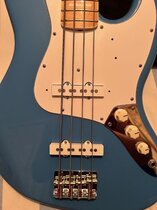 No interest in this at present so withdrawing for now to rethink. I've seen something I want so reducing the price on this a bit to hopefully move it along. For that reason I'm also no longer interested in trades. I've decided to put this Jazz up for sale. It's a great bass but I've decided to look for a real late '70s Jazz. It's a 2017 Fender Japan '70s traditional Jazz Bass in California blue finish. It's an authentic recreation of a late '70s Jazz. The body is ash and the neck is one piece maple with a skunk stripe. It sports full size Japanese Gotoh tuners and the normal Fender bridge. A lot of these Japanese '70s Jazz recreations use '60s spacing for the bridge pickup, but this has the correct '70s spacing and 7.25" vintage radius. This model is not available anymore - the current iteration has a basswood body, smaller tuners and a 9.5" radius A previous owner has customized it somewhat; the white pickup covers and knobs are not original - it would originally have had black ones. I do not have those unfortunately. The body is light swamp ash - the bass weighs 4.2kg/9lbs 4oz. It comes in a fairly lightweight gig bag. The neck is in ideal condition with no marks/dents at all - like new. The body has some dents in it but the paint is all intact. Truss rod works fine, it's currently set up with a very low action with 45-105 Elites Stadiums. I'm in Bristol and you're very welcome to try it out through my amps. Collection preferred - I do not want to post it given the fairly basic gig bag. Happy to drive a reasonable difference for the right buyer however. The only trades I would be interested in would be either a genuine USA '76-82 Jazz, or a 2 band StingRay, with money added from me your way obviously.
 -
During one summer in my university years (sometime in the late '90s) I thought I might switch from my usual pub work to do something else. I applied for, and was offered a job as a charity collecter - or what these days would be termed a chugger. Each day was a different pitch and a different charity. The deal was that for each pound collected, I kept 80p. another 10p (at least this is what I was told - it could have been more) went to the company organising us, and the last 10% to the actual charity (although how much of that actually ended up paying the salaries of staff at these charities and how much went to the intended recipients is another matter). I lasted two days - even as a money hungry 19 year old I could tell the whole thing was rotten. It was essentially high pressure sales, but with a bigger commission and no basic rate. That soured the whole meaning of charity for me for a good few years. Of course, perhaps, things are better now and not all operators are perhaps so cynical, but it is as you say, a business. As a musician, our function band has done one or two charity gigs. We made sure we got petrol money and a meal, and it was a better use of a Saturday night than sitting in front of the television, but the 'exposure' never lead to any gigs.
-
Bass line surprise - “it’s my life” no doubt
Belka replied to jonno1981's topic in General Discussion
https://www.youtube.com/watch?v=oPRPRI65kdk Here's just the bass and drum tracks isolated. It's a great bassline and it's performed superbly. It's interesting how he keeps some notes very short, but uses fretless vibrato on others. Someone mentioned it sounding like a StingRay, but isolated you can hear the woodier characteristic of the Wal compared to the more metallic sound of a StingRay. It sounds like it was DI'ed into the board with no effects - very '80s. Years ago I transcribed both this song and the No Doubt version. Tony Kanal's line is slightly simplified - at the time I thought that maybe the reason why was that they are in different keys - I seem to recall thinking at the time that the key change would have made it harder to reproduce the original bassline note for note but I may be misremembering this. As for the No Doubt version, it sounds like bass guitar but through some kind of ring modulator/bitcrusher at the beginning, and some other kind of fuzz or synth/guitar doubling during the choruses. Other verse parts sound like just bass guitar. It also sounds fairly heavily quantized - you can just about tell it's bass guitar rather than a synth but I'd guess it's been cleaned up/snapped to grid fairly heavily (as was the custom at the time rather than a criticism of what No Doubt did). https://www.youtube.com/watch?v=6Nk3TMyWo1M&list=RD6Nk3TMyWo1M&start_radio=1 -
Well, it's finally finished. In the end I went in a completely different direction with the colour - a subtle pearl white (my first bass hero was Duff from Guns 'n' Roses). The guy who painted it did the neck as well - it now looks less like an original '70s Precision and more like one that was refinished by a hair metaller in the '80s. It sounds amazing too - it's a heavy beast but the ash/maple really gives it some snap, which is exactly what I wanted. The normal deadspot you get on 34" basses is barely there either, which is a bonus. Nice low action too.
- 18 replies
-
- 12
-

-
https://www.talkbass.com/threads/roasted-maple-stability.1432896/ There's a decent thread from the other side on the topic here. To summarise, roasting can improve the stability of less stable woods, like figured maples, but it won't make them stronger - apparently it's typically overdone and actually makes necks weaker/more brittle overall. I'd imaging the MusicMan neck movement issue could be down to the wax/oil rather than sealed finishes, as it seems to happen with both their roasted and unroasted necks. Warwick necks are also known to move a lot. Roasting probably does make a lot of sense for companies shifting a lot of units such as Sire/Harley Benton - it's a way to provide a stable neck without having to dry wood out over years, or to be picky about wood selection, but in the long run, properly dried high quality wood is probably a better bet - The likes of Alembic, Ken Smith, Fodera etc. generally use kiln dried timber that's been left for years in their shops for any signs of movement, and then slice them into laminates. Obviously that kind of approach isn't feasible for mass production, so roasting is a good alternative.
-
Fenderfever has a sale on with some decent reductions
Belka replied to Clarky's topic in General Discussion
I bought a bass from him last year. Transaction was fine - not a great deal of communication but the bass was packed well and arrived promptly. The setup he had done was very good too. He's a tad pricier than Bass Bros or Bass Direct but those reductions more or less bring him in line with them. -
I've found that the BB range has been consistently excellent at all price points. It's one of the best sounding PJs out there, and they are always well put together whether at the budget or MIJ end of the spectrum. I always loved the '90s BBNs ones with the soapbars and quilted maple (although I think the cheaper versions used paper 'foto') tops. I was never quite so inspired by the TRBs - they have a very clean almost Spanish guitar sound going on that is fine for soloing but isn't really my thing - I always preferred Patitucci's Ken Smith sound for example.
-
Mickleburgh sometimes has some decent stuff in, but in recent years the bass selection has been lacking. Rikaxxe has had the same stuff sitting in it for years. They're friendly enough though. If you're a real masochist you can try going into Heron Music or Electric Ladyland. The former has some decent stuff in it, but it can be a bit weird. There's stuff that's been hanging in there for months which he claims is sold and won't let you play, but it never seems to leave the shop. I get the impression he has regular clients who he'd very much rather deal with than walk-ins. The latter is a real experience. He probably won't let you buy anything, the levels of secondhand smoke are ridiculous, and a lot of his stock has come out of a skip, but you get some entertaining stories out of him. Both Heron and Electric Ladyland allude to rooms with the 'good stuff' upstairs, but neither have ever let me see any of it. They both asked me to say what I might be interested in and if they had it they'd show me (I suggested various basses but apparently they didn't have any of it). I did once see a couple of nice basses downstairs in Electric Ladyland - a cherry red fretless '80s Jaydee in good condition (although the amount of cigarette smoke in that shop can't be good for any guitar in there long term), and a 1968 Telecaster bass - he did tell me not to buy that one as apparently it was haunted.
-
I think there are probably some gigs/sessions where a player will be told to use/bring a P bass (Motown revues, certain bandleaders/producers that request it - I've heard this from more than one pro player), but I'd guess it happens a lot less than the SBL and other Youtubers' 'The TRUTH about why the P bass SLAYS everything else' content suggests. It's funny, but some of the P bass sounds I really like were in situations when it was no longer a particularly fashionable bass - Steve Harris, Andy Rourke and Freddie Washington in the '80s, Pino when he brought it back into fashion around 2000 - I don't think any of them were using one because they felt they needed to or that the producer had demanded it.
-
Three years ago I bought a Precision because I had some money burning a hole in my pocket and thought, after watching various YouTube videos with Sean Hurley, that all bassists needed one. I put flats on it, as you're supposed to do, and enjoyed playing it for a few months, but after a while I just kind of stopped. Most of my gigs called for a 5 string and when I needed an approximation of a P bass the neck pickup on the Jazz was close enough, so I eventually sold it. I'm currently putting together a parts P to give them another try. This time it's going to be with a maple neck and roundwounds; I think that to make P basses shine in a lot of modern live mixes you need them as bright as possible to be heard (of course I know that for recording this is different and flats sit very well in a properly balanced mix), and the Precision tones I like generally tend to be quite bright anyway.
-
It's a shame they didn't take any pictures with the pickup covers off. They do give decent enough disclosure about the refret and the changed Japanese pots, so, I'd guess the pickups are original and they just didn't see the need to say anything. Definitely worth checking just in case however. Interestingly, this bass could almost be labelled a mid-late '70s transition item. It has some features of earlier '70s models (the serial number and original knobs, rather than the Strat knobs), and some of the later '70s models (Fender-branded Schaller tuners instead of the bigger 67-76 Fender tuners and smaller headstock logo). Not that these features make it more desirable/valuable however, but definitely captures an interesting turning point in production. The weight, condition and price (the latter is in line with Bass Bros, Bass Direct, Andy Baxter) seem decent for a late '70s Jazz - if the pickups are original and it sounds good I think it would be a good score.
-
I think this is absolutely right, but these days, amongst younger players 'session player' has come to mean any freelancer who plays with more than one band, and is probably just as much (or even more) about live playing than actual recording. The funny thing is, in the past, the great session players all started playing live constantly and then fell into session work - it was probably well-paid and convenient. The best players also still kept doing lots of touring, Anthony Jackson, Chuck Rainey, Pino, etc. These days you get people who actively want to be recording players primarily and are not as interested in live work. Without that foundation of playing with others constantly in different styles/genres they will probably never develop their full potential however. Also, and with the risk of sounding like an old fart, these days the likes of Sean Hurley, great player though he is, have reinforced the idea that being a good sideman/session player is all about a P bass, short scales with flats, dozens of different DI boxes which all just sound like you're rolling off a passive tone control, 'taste', and vintage vibes. While I'm sure that these are essential things you need in the toolbox to have a career these days, it produces players who sound the same. You don't see a lot of risk taking/individuality any more. Back in the '70/80s you had lots of jazz/fusion players hired for pop/rock records, there was a crossover, these days you don't see that. If the likes of Hadrien Feraud/Janek Gwizdala got a few more of those LA pop/rock sessions for being great players, rather than just being able to bring a vintage vibe, they just might make the music more interesting.
-
I remember someone posting about the same bass here back in 2019. It's sat there unsold for at least 6 years. Judging by the wear on the bridge it was played at lot by someone. Kind of sad it's not getting any use. The pawnbrokers could probably put it up on Reverb/Ebay at that price and sell it in a few weeks.
-
I think pre EB MusicMan stuff has also gone up a great deal over the last year or so - it used to be priced similarly to Fender stuff of the same vintage, but the fact that they now have their Retro '70s/Pino basses sold new for over £3000 new means that no-one, shop or private seller, is going to take anything less than £3000 for any pre-EB stuff, unless it's modified/very bad condition.
-
To be honest I've never received a decent offer from any shop for part exchange/buy in, and I think these days Andy Baxter won't accept any part exchange against a commission sale. However, when I sold through him his commission was 15% while a lot of other shops take 20%. It's swings and roundabouts I suppose.
-
To be fair, I think Andy Baxter has a more realistic experience of the market than some other dealers and knows what something is really worth. He tends to get in the extremely rare/valuable stuff perhaps more than others do, and it is often very expensive. However, refinished/stripped/altered basses are often considerably cheaper at his place than other dealers - just recently I've seen refinished mid '60s Fender basses go for around 4K, and early '70s ones for around 2-2.5K. Compare that with the likes of the Gallery and Vintage Bass Room for their '60s/70s refins and he seems much better value.
-
The word over at Talkbass is that Fender has bought/is buying G&L.


