


basstone
-
Posts
238 -
Joined
-
Last visited
Recent Profile Visitors
3,920 profile views


basstone's Achievements


-
thanks for stepping back into the fray again @scrumpymike. How do you want to arrange the payment?
-
Count me in 🙂
-
If there is enough interest and willingness to commit to paying the full price of the Cheddon hall hire maybe we could group together to run the event to take the strain of Mike and his team? It is a great venue which would be hard to beat on price and facilities?
-
Really sad to hear this. Thanks for all your efforts on previous bashes Mike. Most enjoyable. Is there any possibility of looking into alternative venues. It would be hard to find a better hall but I’m sure lots of us will miss the bash!
-
 It would be worth servicing the amp if it's not been done for may years. Over time connections can deteriorate and the cumulative effect can cause increased noise pickup, particularly if the grounding is not totally effective. I've made improvements to several amps by improving screening in critical places, such as unscreened input jumper cables. Some designs are more susceptible to noise pickup than others should not be so bad as to make the amp unusable.
 -
Two Identical Amps - One With Distorted Output
basstone replied to aniki's topic in Repairs and Technical
It may be worth getting the amps checked out by a competent tech. It may be that the valve bias setting is different or there may be failing / failed components in the circuit. It is possible that you have a partially shorted output transformer, but that is uncommon. I'm assuming that the amps are always connected to a speaker load when switched on as valve amps don't like running into a high impedence. -
Behringer bass v-amp pro rack mounted multi-effect unit. - *SOLD*
basstone replied to basstone's topic in Effects For Sale
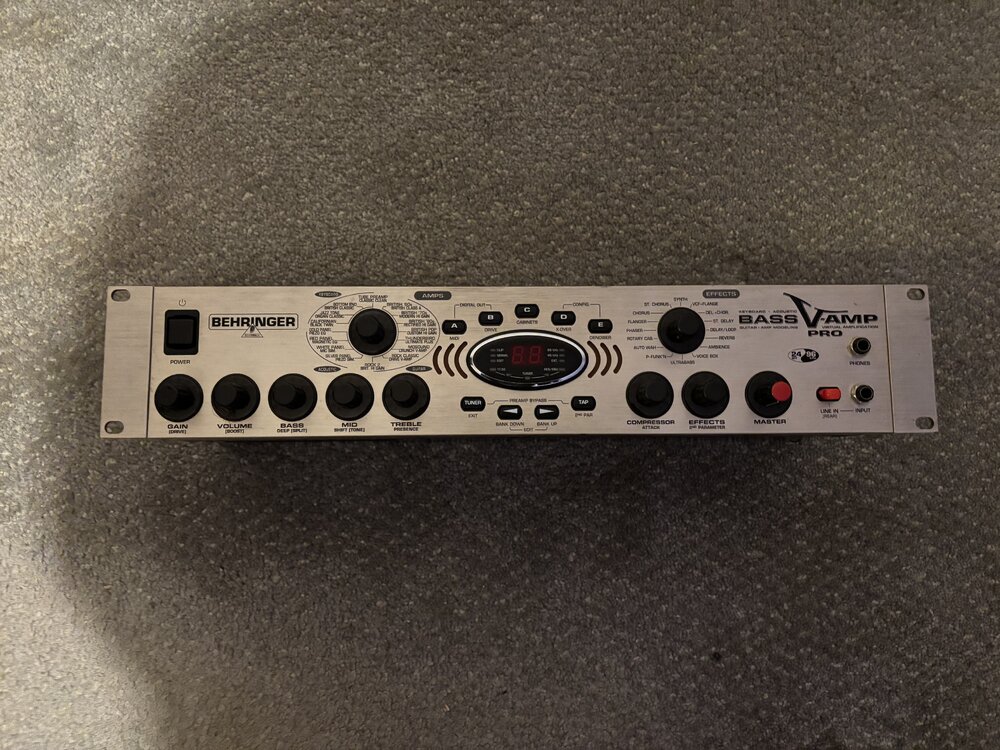 Some info from the Behringer web site: 32 authentic virtual amp models freely combinable with 23 awesome speaker cabinet simulations Stereo multi-effects including ULTRABASS, synth, delay/ loop sampler, chorus, flanger, rotary speaker, voice box, auto wah, phaser, ambience and reverb 125 memory locations including original artist presets Intuitive user interface with direct display of all essential settings Additional effect parameters directly accessible on the unit; Tap-tempo function allows real-time adjustment of effects speed parameter 4 renowned distortion and overdrive stomp boxes with adjustable Drive, Tone, Boost and Split Dedicated wah pedal and studio compressor effects Effective Presence, Deep and sweepable Shift/Shape controls for all amp models Sweepable 24 dB Butterworth frequency crossover for bi-amping operation Adjustable auto-chromatic tuner 15 rear panel connectors allow comprehensive routing and suit virtually every conceivable application Pre DSP send/return for dry recording and wet monitoring Stereo 1/4" Line outputs controlled by master volume for live use as guitar preamp Balanced stereo XLR DI out with ground lift and switchable ULTRA-G cabinet simulation Post DSP stereo inserts for connection of external effects BNC wordclock input for external sample rate synchronization up to 96 kHz MIDI implementation includes program changes, control changes and SysEx, allowing complete MIDI automation through our free Windows editor software downloadable at www.behringer.com
 -
That grille is looking good. One option would be a recessed batten around the whole front of the baffle then screw the grille to that. Also a strip of thin self adhesive foam strip between the grille and the batten helps dampen any tendency to vibrate
-
Just wondering if that metal folding handle rattles at all. All the ones I’ve experienced did!
-
Space heater should do the trick. I used Tuffcab on some big band music stands this timelast year and used a hot air gun and fan heater to help the drying process. Just beware that the paint may remain soft under the outer skin for several days. Somerset also has similar conditions ATM. Hope it goes well
-
Anyone solder wires into mains plugs?
basstone replied to Steve Browning's topic in Repairs and Technical
You could get away with loose screws for most of our gear as the current load is generally small. With a high current load a loose connection creates a higher resistance which can lead to overheating! -
Very clean Behringer bass v-amp pro rack mounted effects unit. It has loads of amp and cab simulations as well as effects and built in tuner. I just don't ever use it these days so here it is! Postage would be about £8 royal mail second class.
-
I’m not sure about Armacab but the Tuffcab paint I’ve used needs a temperature greater than around 10 degrees in order to cure in a reasonable time. I have worked in the winter in my unheated open workshop but used a fan heater to help cure the paint. I’d agree use sacrificial bolts. Wait for the paint to go nearly but not completely dry before removing
-
Thank you for the explanation, I understand now that it's mainly about the practicalities of applying the paint. I've used Tuffcab on some baffles (as it was all I had around at the time) and agree it's tricky to get a consistent finish on the edges next to the grille batten with the roller. I also fit the port before painting, but as you say it's all hidden behind the grille if one is fitted anyway.
-
Is it not a good idea only from the perspective of getting a good seal on the drivers or is there another reason?


