



SumOne
-
Posts
2,380 -
Joined
-
Last visited
1 Follower

SumOne's Achievements



-
I wonder if people had similar discussions when the self-playing 'pianola' was invented.
-
I would be worried if I'd trained as a mastering engineer, or was a commercial jingle/advert music maker or made background music for TV/games etc. those aren't careers that are going to be around so much in 10 years. People making original music recordings are going to be up against more competition, but AI can also help them and there hasn't been much £ to make a living purely in recording music for a while now so I'm not sure if it'll make a huge difference. They make £ performing and merchandise, I doubt AI will make much of a dent in that. Live performers haven't got much to worry about, and people that just like playing instruments have nothing to worry about. I'm not worried as someone who enjoys playing instruments with a band and pub gigging. People have had the option of just listening to recorded music at home for over a century but they still want to go out and see live music and have that human connection (all be it less so nowadays than in previous decades). I wouldn't mind if this makes a change for musicians to go right back to the old folk music type 'turn up to a pub with an instrument and all have a sing along' stuff, or futher back 'hit some drums and have a dance around the fire'! It wasn't a profession to make money from recorded music for most of human history and live musicians weren't put 'hero worship' sort of pedestal but music is always something humans have enjoyed participating in. I'm not sure we need to keep the model of famous multi millionare musicians which after all is only a relatively recent (last 70 years or so) sort of thing enabled by technology (apart for a few 'rock star' type composers before that enjoyed by a small rich % of the population). For most of history, music was not something to make a living from recordings - it was almost exclusively a communal live experience thing, I don't think AI will take that away.
-
If you were starting today, what’s the best way to learn?
SumOne replied to Useless Eustace's topic in General Discussion
....well, I'm currently having piano lessons. And I DJ/produce DnB and Techno as well as being in a Ska/Reggae band playing Bass and occasional keys. And I dep Bass for a rock band. So there is that. -
My latest folly is to try and use an iPad for live gig effects. I already have the iPad and Volt2 interface so this has only cost me an additional £10 for Tonestack app: Works fine at home (limited number of FX for £10 though, additional Bass ones cost extra), I'll try it out at rehearsal this week. If it still seems reliable I'll add a midi footswitch just for tuner/mute and preset switching (for the setlist I need four: clean, distortion, dub, clean + phaser) And to get even more portable and have a tuner without needing to use the iPad screen, theres the iRig HDX
-
If you were starting today, what’s the best way to learn?
SumOne replied to Useless Eustace's topic in General Discussion
I'm gonna disagree with the consensus here and say that Bass isn't an instrument you particularly need formal lessons and grades for (how many people here have done Bass grades vs people on a Piano forum? I'd say much more for Piano as it is more of a solo technical instrument that needs music reading) but Bass is a very 'sociable' instrument - you need to pay along with others to get the feel of what works with a band. So as soon as you can head along to a rehearsal with others, even to just listen in then try and do it. Things like the 'Bass method' books are decent. And there are so many free online resources. I'd say paying for lessons is a 'nice to have' rather than essential. Caveat being that I'm talking from my perspective as a gigging pub covers band sort of Bass player where I feel just listening to recordings to learn what to play, playing live for timing and knowing when to shut up are more important than reading music or knowing what Mode is playing. If you want to read music etc and play at west end musicals then formal training I'm sure it's very important. -
Glastonbury 1995, Oasis Vs The Prodigy at about midnight. I was 15 and my friends wanted to see Oasis, I went alone to The Prodigy. No regrets, I don't think it'd be an exaggeration to say it was life changing stuff (along with Orbital and the Dance tent that year) I was already into that sort of music but that was a year or so before I could get into decent clubs so was a real eye opener.
-
'Lyria 3' AI music has just been released on Google Gemini. I asked it to make an Afrobeat song about a bread shop in Chichester....30 seconds later, it had made a quite decent song, well 'sung' and alright lyrics about bread 'warming hearts in Chichester'. I'd definitely be worried if I was a professional jingle maker.
-
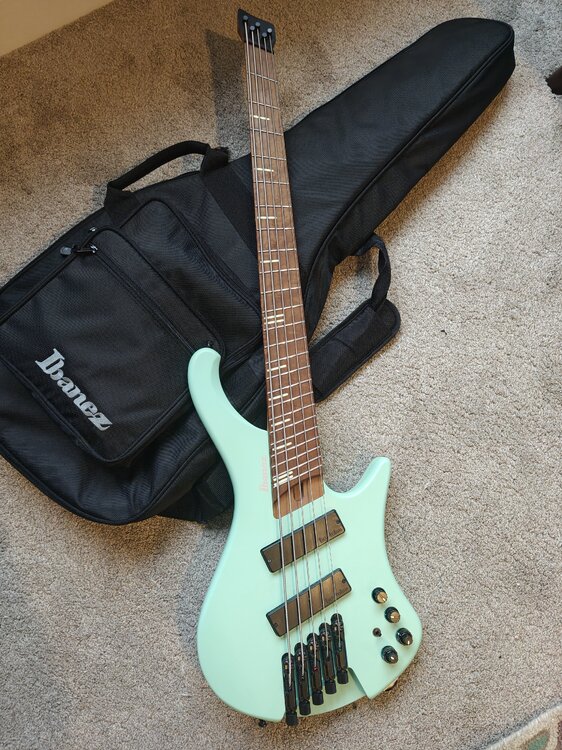 The 4 string I was after has been sold. Trade considered if anyone happens to have a Japanese Fender Jazz 4 string.
 -
Funnily enough, I was also getting a bit disheartened with my teacher's focus on perfecting small seeming quite insignificant stuff - repeat, repeat, repeat again slower, day after day - for weeks! I've been told to stick to one section of one song until perfected - focus on stuff that can feel a inconsequential like timing being slightly off, finger positions, dynamics, pedaling....but I think cumulatively those things are what's important as you progress 'it's not what you play, it's how you play it'. For years I'd just roughly play a song to a 'that'll do' level, I think the value for me in the grades is the focus on the small things that add up to sound a lot better if perfected (and then get good enough to improvise and add feeling). I took my teacher's advice and really committed to just one song, I spent about 6hrs one day this week with that laser focus - if there was a small section I couldn't play I'd slow right down and just keep at it until I had it. 30 mins just on one bar. Repeat. Repeat. I didn't move on from that song all day, and barely played anything else all week. Upshot being I can now play 'The Muppets Theme' quite well, I was sick and tired of it but now I've got it down rehearsing it is much more fun. So I dunno, but personally I think that committed laser focus and repetition for perfecting a small part can pay off. (e.g. for these Grade 3 pieces : 'Tarantella Twist' needed work on dynamics and pedaling, 'Always with me' the finger positions, 'Muppets Theme' timings with both hands), and without being forced to focus I'd have just moved on with a 'that'll do' attitude and not really improved. I think the skills picked up per song translate generally to all my playing and leads to general improvement even though it feels like it's just that one part of a song being over-done. The opposite being my 30 years of general aimless noodling which didn't lead to much improvement... but admittedly was more enjoyable! I guess it is a balance of keeping motivated Vs the focused stuff. I think our teachers are onto something with the focus at perfecting small details as it translates to all playing e.g. if I don't iron out releasing the sustain pedal slightly too soon on a song now then that bad habit will remain throughout my playing, it isn't as much fun as moving on to a new song but is necessary for general progress. I disagree a bit with those saying the grades are rigid 'play like a robot' stuff, one website says what my teacher says about grade 3: "Whilst you may know the note patterns inside out, at this grade level, intention behind the piece becomes more significant." There is room for adding nuance and expression, in fact - it is expected, just needs within the boundaries of the score.
-
I'm in a similar boat: Car insurance, MOT, parking fine, and root canal all paid in the last few weeks. I suppose I am grateful I have the money to pay for those things that seem to me as boring essentials. There are plenty of people around the world without the luxury of owning a car or being able to go to a good dentist. Those sort of on-going monthly 'nothing to show for it' costs make the cost of a new (second hand) Bass seem relatively insignificant though and it's something that tends to last and hold value so feels sort of an investment instead of just waving goodbye to money.
-
At least Bass playing is potentially quite a sociable thing (or even if only playing alone at home - it gives the skills to play in a band at some point). And it is relatively cheap. Most other instruments cost more. A second hand Bass doesn't really depreciate if well looked after. It's basically a refundable deposit. And I think playing music is good mentally. It feels to me like it uses different parts of the brain to my day job. Good for sort of zoning out and I suppose a sort of meditation. I saw the other day that model trains can be £400 just for the engine bit and about £40 a carriage, a decent model railway must cost people many thousands. Many mountain bikes are £3k and expensive to maintain and depreciate quickly. Then look at the cost of hobbies like Golf, vintage cars etc. Bass is positively budget in comparison.
-
The Boss RE-202 space echo is great....it is quite pricey but the RE-2 is cheaper (or the older RE-20 is starting to get cheaper second hand). .....but I didn't actually find much use for it (and the reverb it has) with Bass, e.g. dub reggae is full of delays on just about every part of the music - apart from the Bass that stays as a solid foundation. So I do have my eye on getting one again, but to use with keys rather than for Bass. Perhaps there are certain delays (or genres) that are better for Bass delays though?
-
I think it is a bit unfortunate that Boss have virtual pedals available but instead of charging something reasonable like £10 each as a one-off payment they are charging $49 for 3 months subscription and that is the only option. Apple are charging £5 per month for iOS Logic subscription and subscription is the only option. If virtual pedals are the future then it looks like the big companies will want you to pay monthly...they don't want you getting stuff you could sell second hand, which I do always think is a big benefit of hardware - buying a pedalboard of second hand Boss pedals might cost >£500 initially but then you could probably sell them all 5 years later for a similar price, it's basically a refundable deposit if you look after them. Whereas that $49 every 3 months for 5 years = $980 and once you stop paying you have nothing to sell.
-
I'm probably late to the party on this, but iPad with GarageBand and an audio interface seems to work well for live monitoring and adding some basic effects, key thing being latency is not noticable and it all seems stabel/reliable. It can also do some stuff even quite high-end multi-fx don't tend to do like live EQ visual analysis. Stock effects aren't great but I guess third party ones can be decent, and it has tuner/mute. I've not used iOS for live Bass guitar effects stuff so any recommendations for apps/plugins would be good, low latency being essential. I see Logic on iOS is a subscription only thing now, £5 a month, I'll give the free trial a go. I think this could be quite a portable and useful setup to take to rehearsals: Some basic 'always on' effects and tuner, and the option for metronome and drum loops, recording, playback. etc. And it is an easy setup to just then also use at home for practice and recording, and then with just the iPad on my train commute to arrange tracks etc. This stuff has almost got to the point of replacing multi fx for me, especially as reliability and latency issues seem to be solved, both were real issues just a couple of years ago, it is something Apple things seem to win on. My relatively new and powerful gaming Windows Laptop seems to have a new update to something every time I turn it on, and latency still seems to have a mind of it's own via Reaper - the same saved file will be fine one day but the next time seemingly without changing anything it becomes noticable (presumably a VST, or Windows, or Reaper, or any number of other things has had an update in the meantime and changed to some defaut buffered setting or something - it becoems a headache to figure out what, not something you'd want to do at the start of a gig), the more clossed system of iOS I think helps with stability for stuff like that. For live stuff, the iPad and interface thing would needs a bit of 'gig-proofing' by securing down (perhaps velcro on the iPad and the interface), turning off wifi/updates etc before a gig, and it needs footswitches - I like the idea of wireless options like the Ampero , and the Boss FS-1-WL also looks good as that can be battery powered.


