


SimonK
-
Posts
955 -
Joined
-
Last visited
Content Type
Profiles
Forums
Events
Shop
Articles
Posts posted by SimonK
-
-
What happens on tour stays on tour...
I did a full year on the road over 97/98 with a charity/fund raising/gospel band linked to https://www.mercyships.org.uk mainly in Europe but also South Africa and Ghana. It was fun especially for an 18/19 year old. Started off as a roadie/sound engineer but then got promoted to bass. Learned a few things:
1) No amount of hard work/practice will put you in the same league as naturally talented pro musicians with a good ear (and when you find them just play what they tell you)
2) Gear breaks/goes missing all the time so the simplest set up that ideally someone else has paid for works best
3) Make good use of caffeine especially if you are voluntold to drive the van
4) Music is a fun hobby but too much hard work for not enough reward to do full time
-
 5
5
-
-
4 hours ago, agedhorse said:
4 ohm 410's make a lot of sense because many 410's have a real world power handling of between 600 and 1000 watts RMS, and there's more available volume this was as a single cabinet solution. If you want 2 x 410's, than a 2 ohm capable amp is not that difficult to find.
It has nothing to do with valves versus solid state, there are plenty of examples of 2 ohm capable amps in both types.
If there is enough current available from the amp, then it doesn't matter as they go hand in hand.
No, it's all about voltage x current x cosine of the phase angle between the voltage and current (which is the definition of real power).
Actually, speakers are a current controlled device, the movement of the cone is due to the opposing magnetic fields, one static and one modulating. based on the current flowing through the voice coil. The force F=I x L x B x sin θ (where θ is the angle between the current I and the magnetic field B) The voltage is what causes the current to flow.
Voltage and current exist together, you can't separate them aside from the inclusion of the phase angle between them. The voltage causes the current to flow, the current flows because of the voltage, and the real power is ultimately what matters. Since real power is more difficult to measure, apparent power (which assumes that the power factor (or phase angle between the voltage and current is 1) is most commonly used and is plenty accurate for like comparisons.
Does anyone else feel a small sense of relief when Agedhorse doesn't quote you on a thread about amps? As always valuable insights from the expert (although I'm not convinced 2 ohm capable amps are that common albeit I suspect Agedhorse has a few he has designed)!
-
1
-
-
9 hours ago, Maude said:
Definitely out!
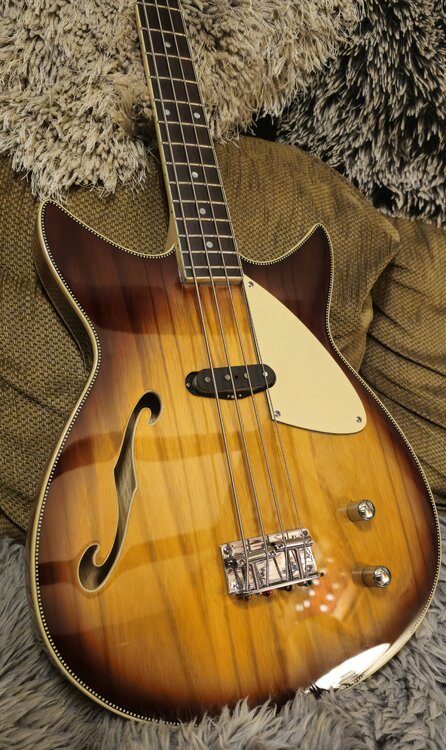
That's lovely - another triumph for the thread that pretends it is not encouraging the most extravagant and unneccessary purchases! 🙂
-
 3
3
-
-
Wow - lots of Trace Elliot fans on here, although not really the new stuff!
-
13 minutes ago, Kev said:
I've never really understood why 4ohm 115/410/112 cabs are made, as I've always felt that they are designed to be in pairs or mixed with one another, and so should be 8ohm to come down to 4ohm total, unless you're running a 2ohm amp. More speakers = more air moved = louder.
I suppose maybe if you're always running your amp at 11, maybe then it makes a bit more of a difference if you're running just one cab, provided the speak cone(s) have enough left to give?
Same here - had a 4ohm 4x10 for years which could never be paired with anything else - managed to find a buyer eventually and now stick to 8ohm cabs only (or at least I did until IEMs killed the joy of playing through a stack).
-
-
56 minutes ago, RichardH said:
From that Amazon page, KZ SF10s are listed as compatible with the SonicFoam SF1 size.
I use Sonicfoam tips, they seem OK. Degrade after a while, but that's the case with all of them I think.
Thanks!
-
21 minutes ago, neepheid said:
All I can say is that if the sound guys at church were so damn keen on everyone using IEMs, they should have provided the necessary equipment. Making it all work is their problem, no?
I got a tier 2 fail for something similar - although went for the more extravagant Swiff wireless IEM than the cheap and cheerful Behringer!
-
2
-
-
No problem playing bass with my wedding ring on, but I do take it off when playing Cajon and am terrified I'm going to lose it one of these days!
-
Does anyone know which of these will fit the ZS10s? I would also like to try some foam ear buds to see if I can get a better bass response. It's OK at the moment but only when I really wedge them into my ears!!
-
Have spent the last three days using IEMs exclusively (at a church conference) and I suspect they will now be here to stay - a sad day for my amps and cabs.
However, apart from getting better ear pieces (I'm using KZ ZS10s), does anyone know a good way of tweaking the EQ on individual channels in the aux monitor mix? We are using a Yamaha TF1 desk and the monitor mix app, and while I can turn instruments up or down, what I really want to do is EQ a bit more thud in the kick, and also take some mids out of the guitar, but there doesn't seem to be a way to do this without changing the main mix. I think the problem I'm having is because I can hear everything so much better through the IEMs the sound engineer part of me wants to EQ it as well!
Alternatively are there any digital desks that have the capacity of EQing aux mixes separately to the main mix?
-
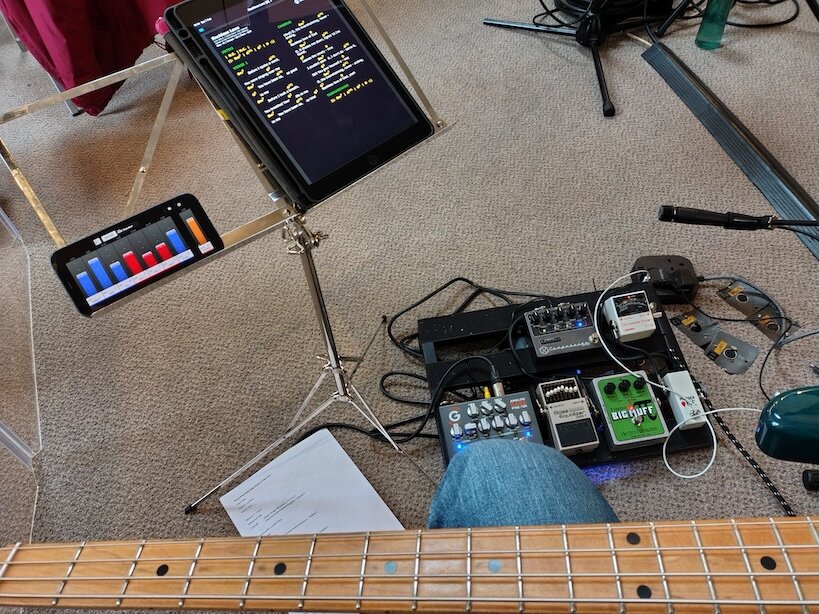
"Staycation" today and tomorrow - going a bit hi-tech in the bass corner. IEMs working a bit better this week although still struggling a bit to hear the kick. This picture is also proof that I used the big muff. Loving the Yamaha monitor mix app now that we've got it to work.
(before anyone asks what the SM57 is doing, it is swung out of the way as I'm sitting on a Cajon that I play for a few things).
-
2
-
-
10 minutes ago, neepheid said:
What are these super special capacitors which can only be sourced from the States?
Yes made me suspicious as well as generic parts for most things can also be purchased - mind you it is true that specific circuit boards often need to be sourced from manufacturers, but thus said if you can get the schematic they can be made for a lot less. However, lateral MOSFETs are apparently a problem: https://www.electronicsworld.co.uk/its-the-end-of-the-production-line-for-the-lateral-mosfet/34469/ but can be solved if you pick up some broken amps and scavenge!
-
1 hour ago, Steve Browning said:
@SimonK is your man available to non-friends (not that I have anything needing repairing at the moment). Reply by PM if you wish. I'll assume no unless you message me otherwise.
...he's the sort of person who will do anything for a bottle of wine so long as the understanding is that he doesn't guarantee results, and if it breaks again and he doesn't fancy/have time to look at it again that's just how it is (although in my experience he has fixed everything I have given him apart from one tricky GP12 that we still can't find the source of a buzz!).
PM me if you have something as we are very close (about twenty minutes from Waterlooville).
-
My relationship to the Trace pre-shape (granted on the GP11/12s) has been to turn it on, play a few notes, say "cool", then turn it off for the gig. The compressor is fine if you don't have anything better on your pedalboard, albeit I normally use compressors for peak limiting rather than anything more drastic.
-
I'm really lucky in that I have a friend who builds amps for a hobby and seems to relish me bringing him something old and broken. I am frequently amazed by quite how quickly he can fix things - often just a component worth pence that needs finding and then switching out. You very seldom need to source something original from the manufacturer (even whole circuit boards can be remade).
We then did the figures for setting up a repair service (and market on forums like this), but to be viable would need to be charging £60 to £100 an hour for labour alone. Problem is a lot of the second hand equipment is worth a lot less than the labour cost to fix it regardless of how cheap the components are and simple the problem.
-
3
-
-
15 hours ago, Vague consensus said:
Thank you all for your replies, it really is appreciated
Pleased to say I went with a Lakland Skyline 44.02
I felt this is the one to start my journey with and keep me motivated to overcome the inevitable setbacks
...you may have just achieved legendary status on this forum going for that as your first bass! Either that or you work in the city and in which case legendary status is revoked.
-
1
-
-
6 hours ago, neepheid said:
Well well well, that's the first month done and dusted, and haven't you all been a good bunch of abstainers? Mostly.
But what an odd January - no-one fell in the first week, so there wasn't a lot to laugh at. Some interesting twists and turns in the whole justification racket (with some enjoyably robust debate - love it), and a few speculative "what if?" type queries which will be monitored closely.
January summary - 1 T1 fail and 1 T2 fail. 37 out of 38 still in (T1), 36 out of 38 still in (T2). Well done all, I'm genuinely impressed, or sorry if you've been eating beans on toast this entire month.
February warnings - I don't know if it's the same in all local authorities, but up here we've got two months off the council tax Feb and Mar. Don't let that extra scratch in your pocket lead you down the path of temptation!
I think you missed my T2 fail after needing to get some wireless IEMs (11th Jan on page 5 of the thread).
-
 1
1
-
-
I suspect the effort that it may take to get AI to write a hit single might be similar to the effort of a person writing it from scratch...
But for remastering/recording/adding instrumentation I think it is a tool that is here to stay, and sadly will take people's jobs.
-
1
-
-
16 minutes ago, SumOne said:
That's very true for those that want to have pride in their artistic efforts. Unfortunately though, the goal for many isn't artistic integrity and having pride in what they've created - it's reaching the goal of making £ and presumably getting AI to fully compose music might be a way of achieving that.
Perhaps this isn't true, but people are suggesting that companies like Spotify and Amazon music are using AI to create music and are promoting it on their playlists as they then don't need to pay royalties. e.g. Ask Alexa to 'play relaxing background music' and it is in their interest to play bland innofensive AI generated stuff they don't need to pay for.
If AI is destroying anything in music/media I think it is the online social media/content creator roles (and I struggle to be sympathetic about this!).
I find myself scrolling far less due to the sheer amount of AI related trash on facebook etc. While online marketing has helped many especially younger musicians over the last ten years or so, I think things may start moving back to the importance of a musician being someone who doesn't create glitzy and technically perfect 20 second online clips, but actually someone who plays real music to real people!
-
1
-
-
I'm increasingly teaching ethics and AI in a University. I use music as quite a good example.
We need to see AI as a tool, and like any tool it can make some work more efficient, but we must not mistake quantity with quality. Generative AI in particular can create large quantities of music etc. very rapidly, but that doesn't mean it is any good. Conversly, in the right hands, AI can help creators generate really high quality work - for me the main benefit of AI in music is more in recording/remastering than composing (for instance).
There's plenty of aphorisms about this but I quite like: "Those who are carried to a goal should not think they have reached it" regarding AI - it's one I use with my students and coursework!
-
2
-
-
On 27/01/2026 at 10:56, TimR said:
Interesting fact. Everyone's ear canals are different lengths and shapes (that should not come as a surprise) which means everyone hears things differently to everyone else. If you swapped your ears for someone else's, your brain would really struggle to understand what it was hearing.
The same is true for eyes. What one person's eyes present to the brain as red is different to what someone else's do.
Which is OK, because we calibrate our ears so that an F# is an F# no matter who you are. It does mean that one resonant frequency for one person would be different for someone else.
Philosophers call this "Qualia" which is loosely defined as the "what it is like" of experiencing something. The kicker is that we can never know what it is like to experience something from someone else's perspective, and thus the best we have is indirect evidence from others who act/report the same sort of things as we do for a given experience/stimuli. There's also the fact that while not identical, our biology is close enough to others to infer that what I experience as the colour "red" is most likely pretty similar to what you experience, but we can never know for sure.
Probably the most famous discussion on this is Thomas Nagels' "What is it like to be a bat".
But this is high falutin philosophy, with IEMs it probably is just minor differences in ear shape!!
-
3
-
-
1 hour ago, xgsjx said:
Sorry, but that sounds like a lame attempt at defending corruption, slave labour & paedophilia. All heinous crimes of which Hillsong have been found committing. They've been caught multiple times over the years, yet still continue to act like a trump.
And yes, there are many companies, artists and organisations that I steer well clear of because of similar issues.More people should too, instead of turning a blind eye & letting them away with it.
What you have to think of, is that playing or buying these songs is funding them to do more of the same.Would you go & help fund another convicted assailant such as Gary Glitter because you like their songs?
There is no excuse that can validate and nullify crimes against children.
Sadly Christianity has been complicit in some of the most horrendous crimes of the last couple thousand of years, and indeed the argument that many people give about not wanting to have anything to do with religion for this reason and instead pursuing secular humanism is entirely reasonable on this basis. Furthermore, if you follow contemporary Christian worship over the last thirty years or so, almost every one of the big worship marques has had a scandal/fall from grace at somepoint (or if they haven't yet they are probably about to) meaning that we wouldn't be able to use anything.
For me, where art or technology are concerned, I prefer to separate the product from the author/creator, but nevertheless if you were in my congregation and specifically raised these songs and told me why you prefered for them not to be played I would absolutely, and prayerfully, consider the perspective.
-
1
-
-
Whenever we have preamp threads more people recommend the Tech 21 than anything else. Thus said I really like my Genzler Magellan pre because it has two very different "flavours" (foot switchable), a HPF, mute switch, and really powerful EQ settings. Not sure if it sounds like "tubes", but through the IEMs yesterday it sounded awesome (albeit I also add a Keeley compressor as well).


2026 Gear Abstinence Thread
in General Discussion
Posted
Oooh... so if I walk into a bass store and buy something without thinking it through in advance it doesn't count as a purchase? I think I'm beginning to like this game.... but may need some sort of letter of authority from the mods to show my wife...