All Activity
- Past hour
-
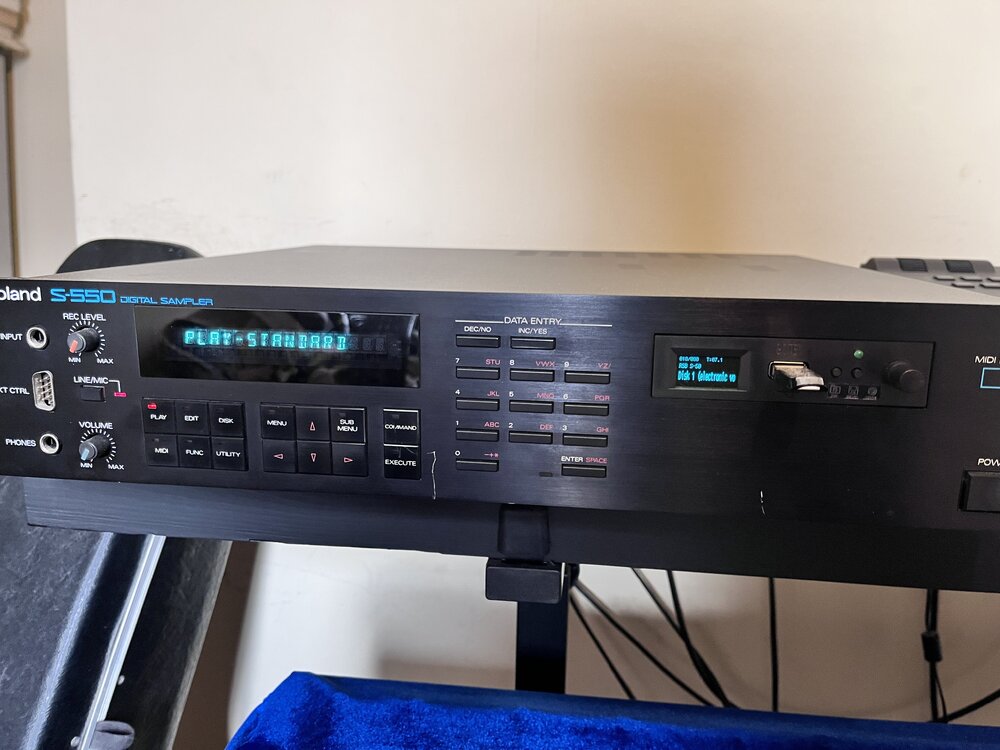 Up for sale is this beautiful 12 bit sampler from around 1988. It's a Roland S550 with 8 separate outs and a top end GOTEK drive (with LCD screen) ready stocked with most of the available sample libraries and several hundred blank floppies. The sound in the video is the classic 'Air' choir. The library runs the full gamut of Roland's offering plus lots of other stuff including drum machines/ synths. acoustic instruments etc It's very powerful with the multiple outs. Monitor included. It's B/W and is essential for running the S550 to its full extent. It's in great nick and includes the original box and a manual etc It's a fantastic piece of gear and sounds very good indeed, but I need to streamline due to lack of space. Apologies for the rubbish pic of the back, it's a bit close to the wall for a wide shot but it looks nice and clean and, most importantly, all the outputs work! Pick up only nr Tun Wells/Ashford IMG_4455.mov
 -

 Check the wanted ads- someone's looking for one of these
 -
You misunderstand... M is the sum of the 2 stereo tracks, call them tracks 1&2, or A&B, or X&Y, and S is the difference between the 2. When I worked in BBC sound we didn't have a plug-in to do the coding or decoding for us, we'd do it via a jackfield with parallel blocks and a phase reverse lead... If you've recorded in M&S, then one of the tracks is the mid signal, and the other is side.
-

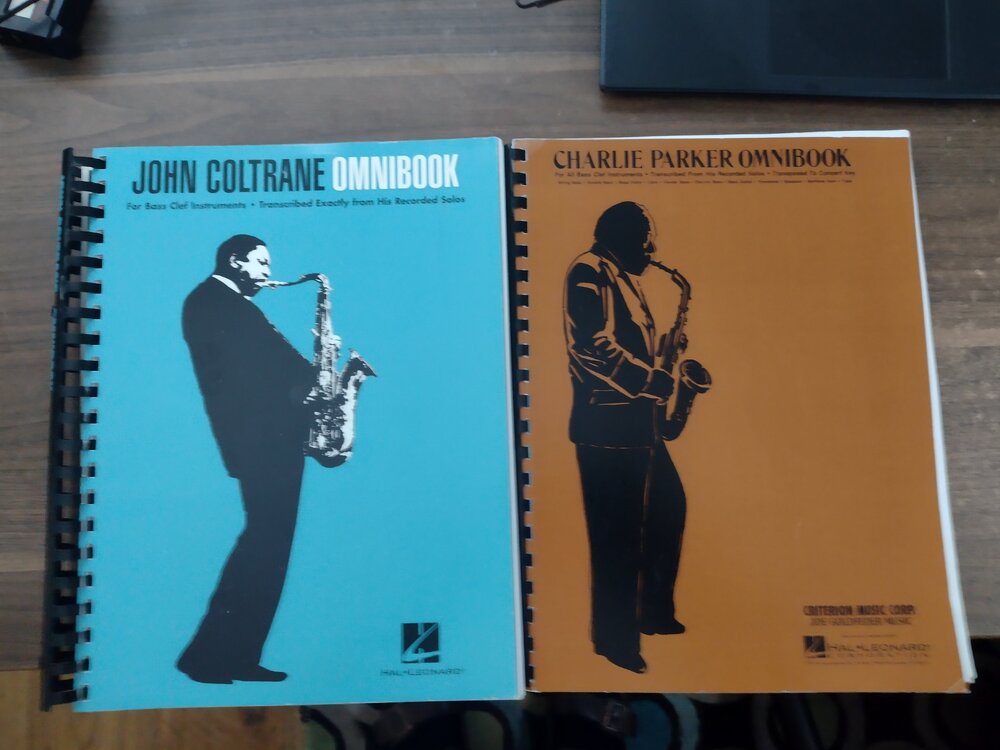 And another PM for Tower Of Power book
 -

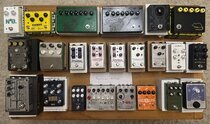 PM sent
 -
Sold Paddy my Squier CV Mustang bass. A pleasure to deal with, great communication along the way. We met in a McDonald's car park to make the exchange and it was rude not to grab a bite to eat after 😁 Wishing you all the best with getting back on the horse @paddy109
-
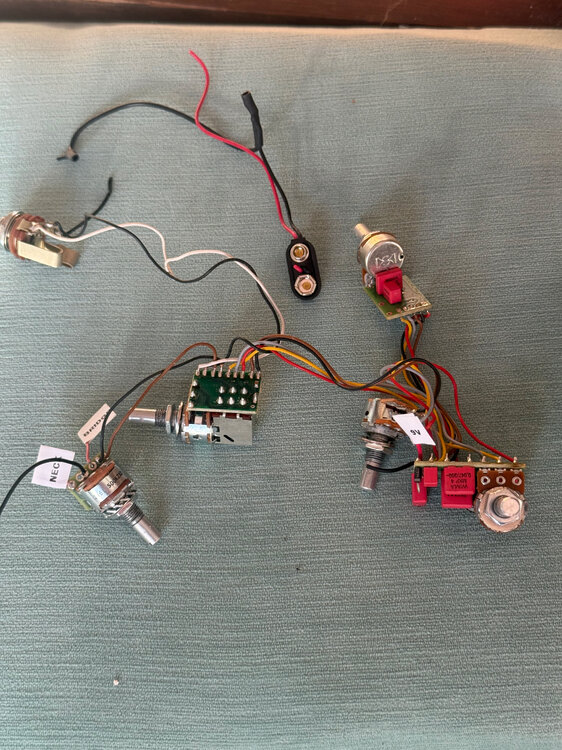
.thumb.jpg.22a7cf668d463c6c367b4c70870ef231.jpg) Taken out of a bass and all there. The relevant connections have been labelled and the black ones are to ground. Lovely sounding preamp with push pull passive/active bypass on volume. Treble pot then acts as a master tone in passive. £60 posted to you in the uk
Taken out of a bass and all there. The relevant connections have been labelled and the black ones are to ground. Lovely sounding preamp with push pull passive/active bypass on volume. Treble pot then acts as a master tone in passive. £60 posted to you in the uk -
@Paulhauser
-
My moto is life is a book, and nobody wants to waste time reading a boring book so fill your book with amazing adventures, experiences and achievements. It doesn't matter how big that book is, but like all books it needs a start and will always have an ending so make the bit in the middle amazing. As SumOne above says, nobody is ever going to say, 'I wish I watched more daytime telly alone'. 🤣
-
 Sure, it would look better with a matching headstock, but it's much nicer than this monstrosity.
 -
How did you get on programming the MIDI switcher?
-
 stefano.cirillo1977 joined the community
 -
New Spector Euro line - The Euro CST Series
stefano.cirillo1977 replied to cetera's topic in Bass Guitars
For the benefit of people with the G string problem on the 5-string bass. After several discussions with the guitar shop owner (trying to understand why there was this issue), we solved it easily. First of all, this issue affects only the 5 string. And only the p-pickup. The 5-string has an odd number of strings, so the split pickup should take care of the first 2 strings with one side of the pickup and 3 strings with the other side. The reason why the G string has a lower volume is because it has been switched with the p pickups, so the side with two strings to take care of has 3 poles and the side with 3 strings has only 2 (resulting in the G string without a proper pole associated). To solve it, simply switch the p bass pickups, and you will be fine. You’re welcome. -
A few things are incorrect here - with M/S recording, M is not track 1 + 2. M is simply track 1 and S is simply track 2. When they are decoded (easily done with a simple plugin, or you can do it manually), they then give an L/R output (instead of M/S). When decoded, L=M+S and R=M-S, and as you state, the difference gives the stereo information. When summed backed to mono, the S signal is completely discarded, giving strong mono compatibility from the (hopefully) well-placed M mic. With 'ordinary stereo', it's not always a crossed pair of mics. There are two fundamental approaches: *Co-incident stereo arrays (which is a crossed pair of mics, as close as possible to being in the same point in space) - these rely on the microphone polar patterns to achieve level difference between the same sound hitting both mics. So a sound coming from the left (for example), hits both mics at the same time (because they're in the same point in space), but the left mic will be facing the sound, and therefore picks it up stronger, and so when played back, the sound will appear to be coming from the left. For this reason, omnidirectional mics don't work in a co-incident pair because they're equally sensitive all round although in practice, you'd probably get some sense of width at higher frequencies unless you managed to get hold of a perfectly matched pair of perfectly omnidirectional mics... which I don't think exist!) There are many variations of co-incident stereo, using different polar patterns and mutual angles. Figure-8 mics at 90 degrees are the classic 'Blumlein pair', which gives great results in a good acoustic, but needs to placed quite far because the stereo recording angle is quite narrow (which exaggerates the width if placed close). Cardioid mic at 90 degrees is also seen often, but are often unsuitable and quite useless because the recording angle is so wide, it gives a narrow image where everything in front of you is bunched up around the middle. It can be useful to record ambience all around you, or when you have to really close to the source. Co-incident arrays usually gives a very pinpoint placement of sources, but can sometimes lack spaciousness. *Spaced arrays - In a spaced array, the mics are spaced apart (by anything from a few CM to a meter or two), and are therefore not at the same point in space. Because of this, they depend on [i]time of arrival[/i] differences to create a stereo image instead of level differences. Put simply, when the mics are spaced, a sound coming from the left will hit the left microphone before reaching the right microphone. Again, there are many variations using different polar patterns and spacings for a different recording angle, with spaced omnis probably being the most useful, and cardioids again being quite limited in their usefulness. Spaced arrays usually sound more spacious, but more vague in their imaging. A lot of the most popular stereo techniques (at least in classical music), combine the two methods. Common techniques such as ORTF rely on a mutual angle for level difference (like a co-incident pair) combined with a slight spacing between the mics for time-of-arrival differences (like a spaced pair). In the case of ORTF, it's a mutual angle of 110 degrees between mics, and spaced 17cm apart. All this is quite irrelevant to bass playing though... these 'proper' stereo techniques are about giving a fairly natural representation of an acoustic soundstage. They are treated as 'one system', not 'twi mics'. There are plenty of other ways to get stereo 'results' without taking the above approaches (drum overheads, for example, are rarely a 'proper' stereo technique, but the results are still fine), and of course it's quite common on acoustic instruments to use two mono mics panned apart (by this I mean two mics placed intentionally to pick up a different sound - e.g one by the bridge and one nearer the neck. It's not a true stereo array, but can give nice results in stereo.) but stereo feeds for your IEM can be very enjoyable as you can move sources around to match where they are on stage, or wherever you'd like. It doesn't matter if the sources are mono - they can still be moved around the stereo field. Your own bass will be mono of course unless you use stereo effect. And now I'm realising that I'm responding to something posted in January...!!!
-
Hi all, Having a play with a yamaha 734a this week. This has been on my wanted list for probably 10 years, or at least since they came out. Very distinctive look and cool. We'll, after 2 days I can say I love it. Granted it took quite a few hours to get used to. There is SO much tone control it's unreal. The passive p tone is absolutely perfect, yet the passive tone control (the treble knob when in passive) helps you dial it to perfection. Flick it to active and you've a whole lot more tone to dial with. Turn it to rear pickup and it's lovely and growly. Thinner and tighter. Put again either the tone control or active eq allow you to move to your taste. Personally I start at either end of the pickup selector, dial in a nice sound then move the pickup blend to either make it warmer and fatter or thinner and tighter. Works a treat. The bass is nice and light. It also has a lovely shallow neck. Both making it easy to play. This one has emg pickups, did they come as standard?
-
 ChrisRodgers joined the community
 -
.thumb.jpg.52236fb3fc5f7192c6d4345d6b9bd2d8.jpg)
Out of phase - Need help - Passive EMG (GZR/MMHZ)
MartinB replied to K-2's topic in Repairs and Technical
Result! Glad you got it sorted. Neither pickup is really to blame - if they're out of phase with each other, then it doesn't matter which one you reverse. -
TV Dinners - ZZ Top
-
 Mooer Ensemble Queen chorus pedal (mini format) in excellent condition. No longer needed and selling all my current pedals. £25 plus a few pounds delivery. £29 to your door! Get in!
-
- 1
-

-
57 Channels (And Nothin' On) - Bruce Springsteen
- Today
-
Throw Away Your Television - RHCP again.
-
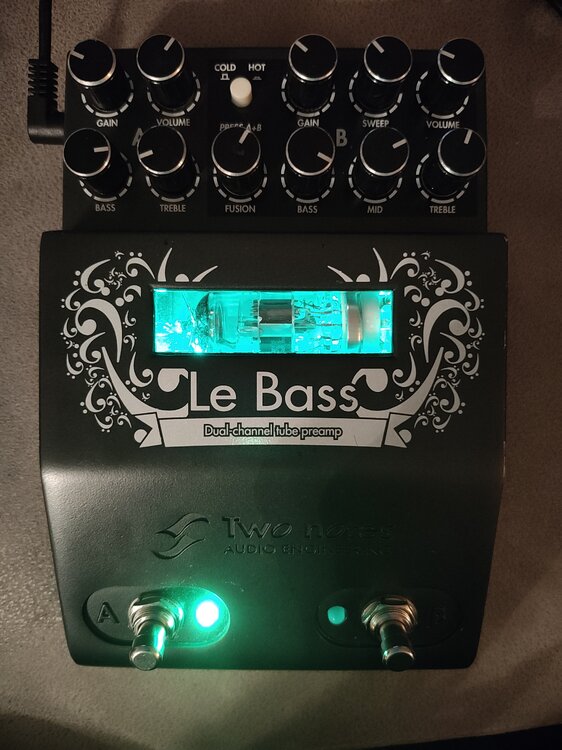 Replied to in October. Still available.
 -
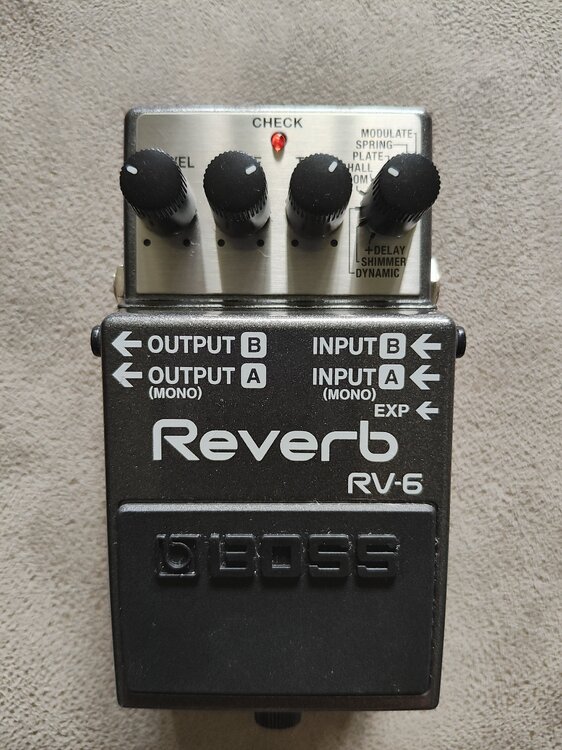 Yes it is.
 -
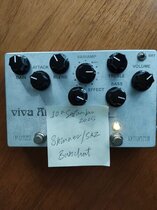 Now £330.00. This amazing emulation of the acoustic control corporation 360 preamplifier with variamp and built in fuzz is up for grabs. Hand made by the renowned JC Maillet and commissioned and imported by myself at great cost. I have used the 360+ for studio recordings, gigs, rehearsals and at home, it has never dissapointed. The preamp sounds fantastic and the fuzz section is the best I have used. I have owned this pedal for a good few years from new, as can be seen it's in pristine condition. Specially sourced UK power supply also included. Will happily run from other sources with the right leads (I used it with a trex chameleon). Fully detailed printed instruction manual also included. Only available as I have more preamplifiers than I can use. Try out/collection always welcome, or UK insured postage for £15.00
-
- 1
-
-
 😄
😄 -

How was Your rehearsal last morning or night ?
Stub Mandrel replied to nilorius's topic in General Discussion
Insight(?) into our creative process 🤣 -

Out of phase - Need help - Passive EMG (GZR/MMHZ)
K-2 replied to K-2's topic in Repairs and Technical
So, thought I leave this here for anyone in the future looking for an answer. I contacted EMG directly, but they were closed for thanksgiving, so only got a response back. They told me, that the culprit in here would be MM pickup, rather than P. Was advised to swap green and red cables on the MM connector. Using a needle you can release cable pins, swap places and connect back. Out of phase issue is fixed and it was a fairly quick and simple thing to do (had to ask my wife to use her little fingers to swap the cables, hehe) Attaching some pictures if explanation isn't clear enough. Picture 3 shows them using a screwdriver to flip the locking mechanism up. Cheers!



.thumb.jpg.22a7cf668d463c6c367b4c70870ef231.jpg)


.thumb.jpg.52236fb3fc5f7192c6d4345d6b9bd2d8.jpg)